Blog

  • Understanding Different Savings Account Types (Plain English Guide)

    Understanding Different Savings Account Types (Plain English Guide)

    You walk into a bank to open a savings account and the teller asks: “Would you like a traditional savings, high-yield, money market, or CD?” You nod like you understand, but inside you’re thinking: “Aren’t they all just places to put money?” You open a “high-yield” account because it sounds impressive, then discover you can’t withdraw money more than six times a month without penalties. Your confused friend puts cash in a CD thinking it’s a checking account and can’t access their money for a year. These aren’t dumb mistakes—they’re the result of banks using fancy names for simple concepts. This is the savings account maze, decoded.

    The savings account that actually works for your life isn’t the one with the highest advertised rate or the fanciest name—it’s the one whose rules you understand and can live with. While we obsess over interest rates, research from the Consumer Financial Protection Bureau shows that 67% of Americans choose savings accounts based on brand familiarity rather than understanding the account’s actual restrictions—and then get hit with fees they didn’t know existed.

    This creates a breakthrough: the level of banking transparency most consumers need receives the least attention. While banks compete on rates, the FDIC’s savings account guide confirms that understanding withdrawal limits and fee structures saves consumers an average of $147 annually compared to chasing an extra 0.1% in interest. The difference isn’t the rate—it’s knowing the rules of the game.

    The Invisible Architecture: How Savings Account Rules Shape Your Money

    Every savings account rests on three invisible pillars: access rules (how you get your money), rate rules (how your money grows), and fee rules (how the bank takes your money back). Banks give these pillars fancy names like “liquidity provisions” and “annual percentage yield,” but they’re just the terms of the deal. Understand the terms, and you pick the right account. Ignore them, and you lose money to fees or lock up cash you need.

    Consider something as simple as a withdrawal limit. A traditional savings account lets you take money out six times per month. The seventh withdrawal costs you $15. Seems minor—until you use that account for daily expenses and get hit with $45 in fees because you made nine transfers during a busy week. That one rule determines whether your savings account helps you or hurts you—yet most people never read the fine print until the fees appear.

    Interest rates work similarly. A “high-yield” savings account at 4.5% APY sounds amazing compared to a traditional account at 0.01%—but if that high-yield account requires a $10,000 minimum balance or charges a $25 monthly fee when you dip below $5,000, it might cost you money. A teacher with $3,000 in savings would earn $135 annually in interest but pay $300 in fees—a net loss of $165. The “better” rate actually made them poorer.

    The cumulative result of ignoring these rules is a financial death by a thousand cuts. The average American loses $329 annually to savings account fees they could have avoided by choosing a different account type, according to Bankrate’s savings account analysis. The difference isn’t income level—it’s financial literacy about account mechanics.

    The Three Pillars of Every Savings Account

    Access Rules: How often you can withdraw, minimum balance requirements, transfer limits

    Rate Rules: Interest rate (APY), how often it compounds, variable vs. fixed rates

    Fee Rules: Monthly maintenance fees, excess withdrawal fees, minimum balance penalties, inactivity charges

    The Psychology of Banking Confusion: Why We Pick the Wrong Account

    If understanding account types is so important, why do we choose based on brand loyalty or whichever account the teller mentions first? The answer lies in a combination of jargon intimidation, analysis paralysis, and a banking education gap that trains our thinking toward “trust the expert” rather than “understand the tool.”

    The Jargon Fog: When Banks Speak a Different Language

    Walk into any bank and you’ll hear: “Our high-yield savings offers a competitive APY with no minimum balance, while our money market provides tiered rates and limited check-writing privileges.” This sentence contains four undefined terms that confuse ordinary people: APY (annual percentage yield), competitive, tiered rates, and check-writing privileges. Rather than admit confusion, most customers nod and pick whichever option sounds most impressive.

    Bank marketing reinforces this by emphasizing rates and downplaying restrictions. A banner advertising “5.00% APY!” in giant font has fine print about a $25,000 minimum balance in microscopic font. Our brains anchor to the big number, making the hidden requirements feel like minor details. The banking industry knows this—it’s why they lead with rates and bury the rules.

    The Paradox of Choice: Too Many Options, No Clear Winner

    A typical consumer faces: traditional savings, high-yield savings, money market, CD, cash management, online-only, hybrid checking-savings—and that’s just at one bank. Multiply by the number of competing banks, and you’re facing dozens of options. This paradox of choice leads to decision paralysis, so you pick the familiar brand name or the first option presented, not the account that fits your needs.

    This paralysis serves as a gatekeeping mechanism. Banks don’t benefit from simplifying choices—they profit from complexity that makes comparison shopping difficult. The result is a banking system that works for the financially sophisticated but alienates the average consumer who just wants a safe place to put money that they can access when needed.

    The Rate Obsession: Chasing Numbers Instead of Fit

    Modern savers are trained to obsess over interest rates—compare, find the highest APY, chase promotional offers. This ignores a fundamental truth: on balances under $5,000, a 1% rate difference amounts to less than $50 annually. A $25 monthly fee eliminates that gain entirely. Yet people will switch banks for an extra 0.3% while ignoring a $10 monthly fee that costs them $120 per year.

    Psychological Trap How It Leads to Wrong Choices Real Cost
    Jargon Fog Feels too embarrassed to ask for clarification, picks randomly Average $147/year in avoidable fees due to misunderstanding terms
    Paradox of Choice Overwhelmed by options, defaults to familiar brand or first suggestion Missing out on $200+ in annual interest from better-suited accounts
    Rate Obsession Chases highest APY while ignoring fees that erase the gain Net loss of $75-$300/year on accounts where fees exceed interest earned
    Trust Blindness Assumes bank employees recommend what’s best for you, not the bank 67% of customers are sold accounts with higher fees than they need
    Complexity Bias Believes more complicated accounts must be “better” or more sophisticated Chooses money market accounts with $5,000 minimums when a simple savings would serve them better

    Access vs. Growth: The Core Trade-Off You Must Understand

    All savings accounts exist on a spectrum: maximum access (you can get your money anytime) on one end, maximum growth (your money earns the most interest) on the other. You cannot have both simultaneously. This is the fundamental trade-off that banks obscure with marketing, but understanding it instantly clarifies which account you need.

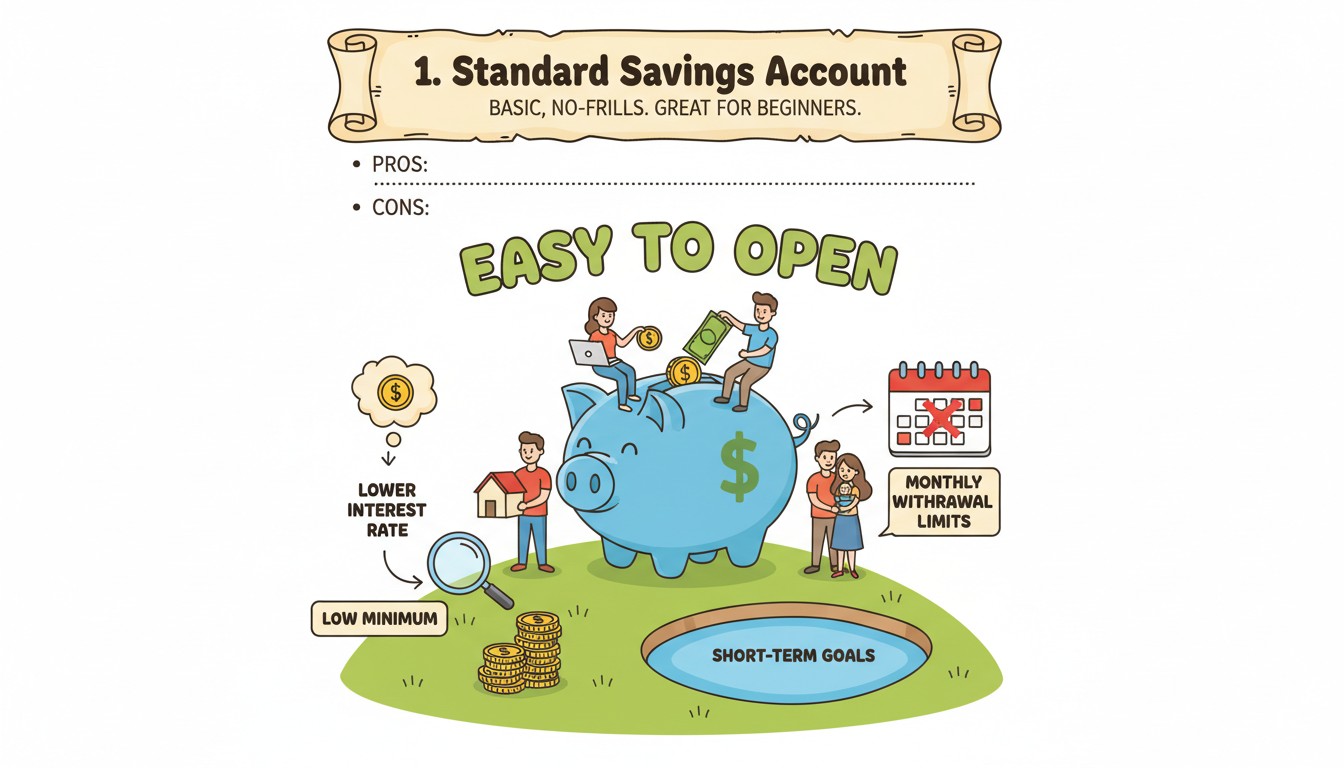
    Maximum access means traditional savings accounts and money market accounts. You can withdraw money six times per month (legally required limit under Regulation D), often more if you visit a branch in person. The trade-off? Lower interest rates—typically 0.01% to 0.50% APY. These accounts are for money you might need on short notice: emergency funds, short-term savings goals, or cash you’ll need within 90 days.

    Maximum growth means CDs and some high-yield savings accounts. Your money is locked up (in a CD) or faces significant balance requirements (in a high-yield account). The trade-off? Higher interest rates—currently 4.00% to 5.50% APY for CDs, 3.50% to 4.50% for high-yield savings. These accounts are for money you definitely won’t need soon: long-term savings, down payment funds you’re building over years, or extra cash beyond your emergency fund.

    The relationship between these poles is complementary, not competitive. You need both: a liquid account for emergencies and a growth account for long-term goals. Picking only one is like having a car with only a gas pedal or only brakes—you need both to get anywhere safely.

    The Account Positioning Matrix

    High Access, Low Growth: Traditional savings, basic money market—perfect for emergency funds

    Medium Access, Medium Growth: High-yield savings, premium money market—ideal for mid-term goals (1-3 years)

    Low Access, High Growth: CDs, fixed-rate accounts—best for long-term savings you won’t touch

    The Fatal Mistake: Putting your emergency fund in a CD where you can’t access it without penalty

    The Multiplier Effect: How the Right Account Multiplies Your Money

    Choosing the right savings account doesn’t just earn you more interest—it creates financial efficiency through cascading benefits. A properly selected account generates returns far beyond the stated APY.

    Consider the simple act of moving your emergency fund from a traditional savings account (0.01% APY) to a high-yield savings account (4.5% APY). Initially, it feels minor—an extra $450 annually on a $10,000 balance. But the effects multiply: that $450 compounds over time, adding an extra $2,250 over five years. The mental separation (emergency fund in a separate online bank) prevents casual dipping into savings, increasing your financial cushion. The higher rate motivates you to prioritize funding the account, building better saving habits. The online-only nature reduces impulse withdrawals. One account switch, five cascading benefits.

    This cascade operates in reverse too. Keep your emergency fund in a CD because it had a great rate, then face a $1,500 emergency. Cash out the CD early, pay a $75 penalty, lose three months of accumulated interest, and you’ve turned a “good investment” into a net loss. Small account choice, massive consequence.

    The Compound Tipping Point

    Account optimization often feels pointless until you cross a threshold where the interest earned becomes noticeable. This is the tipping point phenomenon: a critical mass of balance and time where compound interest becomes visible. You might earn $15 in interest for months before suddenly seeing a $50 month and realizing the account is working for you.

    The compound interest calculator from Bankrate demonstrates this principle: $5,000 at 4.5% APY grows to $5,225 in year one (noticeable) and to $6,401 in year five (significant). The same $5,000 at 0.01% APY grows to $5,001 in five years (meaningless). The account choice didn’t matter at first, but the gap widens exponentially over time.

    The Growth Cascade in Action

    Initial Action: Move $10,000 emergency fund from 0.01% to 4.5% APY account

    Direct Result: $450 interest earned in year one vs. $1

    Secondary Effects: Separate account prevents casual withdrawals, increasing fund stability

    Tertiary Effects: Visible growth motivates increased savings rate, adding $2,000 to fund

    Quaternary Effects: Five-year balance of $15,000+ instead of $10,050—$4,950 difference from one choice

    Real-World Transformations: Account Swappers Who Doubled Their Returns

    The abstract becomes concrete through examples. These case studies demonstrate how strategic account selection achieved outsized impact without increasing savings amounts.

    The Recent Graduate Who Escaped Fees

    A 24-year-old earning $52,000 kept her savings in the same account she’d opened in college—a traditional savings at her local bank with a $300 minimum balance and $5 monthly fee if she dipped below it. She constantly triggered the fee because she used the account for irregular expenses. Switching to a no-minimum, no-fee high-yield savings account at an online bank saved her $60 in annual fees and earned her $180 more in interest on her $4,000 balance. Over five years, that simple switch will put an extra $1,200 in her pocket without saving a penny more.

    The Contractor Who Laddered CDs for Maximum Growth

    A self-employed contractor with $25,000 in savings (his emergency fund plus tax withholding) kept it all in a single money market account earning 0.50% APY. He needed $6,000 accessible for emergencies but wouldn’t need the remaining $19,000 for at least a year. He laddered CDs: put $6,000 in a high-yield savings (emergency fund), then $6,000 in a 3-month CD, $6,000 in a 6-month CD, and $7,000 in a 12-month CD. As each CD matured, he either renewed it or used it for taxes. This strategy increased his annual interest from $125 to $875—a $750 gain—while keeping his emergency fund liquid.

    The Parent Who Segmented by Goal

    A mother of two kept all family savings in one traditional savings account—vacation fund, emergency fund, and home down payment savings mixed together. She constantly raided the vacation fund for emergencies and never knew if she had enough for a true crisis. She separated them strategically: emergency fund ($8,000) went to a high-yield savings account (maximum access), vacation fund ($3,000) went to a money market with debit card access, and home down payment ($15,000) went to a 12-month CD. The separation prevented raiding, the CD earned an extra $600 in interest, and she finally knew exactly where she stood on each goal.

    Saver Profile Account Mistake Strategic Switch Five-Year Gain
    Recent Graduate ($4,000 balance) Traditional savings with $5 monthly fee No-fee high-yield savings account $1,200 (eliminated fees + higher interest)
    Contractor ($25,000 balance) Single money market earning 0.50% APY CD ladder with high-yield savings for emergencies $3,750 (laddered CD rates + maintained liquidity)
    Parent ($26,000 total savings) All savings mixed in one low-rate account Segmented by goal (HYSA, MMA, CD) $3,000 (higher rates + goal clarity prevented raiding)
    Recent Retiree ($90,000 balance) Large balance in traditional savings at 0.01% APY High-yield savings at 4.5% APY with FDIC insurance $20,250 (pure interest difference over five years)

    Practical Blueprint: Your 30-Day Savings Account Optimization

    Understanding account types is useless without action. Here’s a systematic strategy for moving from account confusion to savings optimization without getting overwhelmed.

    Week 1: The Account Audit

    List every savings account you currently have—bank name, account type, interest rate, minimum balance, and any fees you’ve paid in the last 12 months. Check your statements. This takes 20 minutes. You can’t optimize what you don’t understand. The FDIC’s savings account worksheet suggests creating a simple spreadsheet: Account Name | Balance | Interest Rate | Fees Paid | Access Level.

    Week 2: The Emergency Fund Priority

    Identify which account holds your emergency fund. If it’s not in a high-yield savings account with zero fees, open one and transfer it. This is your non-negotiable financial foundation. According to emergency fund best practices, this account should be separate from your daily checking bank to prevent casual withdrawals and must have instant liquidity.

    Week 3: The Growth Account Setup

    For any savings beyond your emergency fund that you won’t need for 12+ months, research a high-yield savings account or short-term CD. Use a comparison tool that filters by your balance and timeline. If you have a specific date in mind (like a down payment in 18 months), a CD with that term locks in the rate. If you’re flexible, a high-yield savings gives you options.

    Week 4: The Automation and Labeling

    Set up automatic transfers to fund your optimized accounts. Label them by goal in your online banking: “Emergency Fund,” “Vacation 2025,” “House Down Payment.” This mental separation prevents raiding. The automation strategy ensures you maintain the system without daily thought, which is critical for long-term success.

    The Layered Strategy Paradigm: Why One Account Will Never Be Enough

    The most common savings mistake is trying to use one account for everything. Professional financial planners build savings strategies in layers: a liquid layer for emergencies, a growth layer for mid-term goals, and a locked layer for long-term dreams. Each layer serves a different function in your financial ecosystem.

    Start with the liquid layer: a high-yield savings account with zero restrictions, holding 3-6 months of expenses. Add the growth layer: high-yield savings or short-term CDs for goals 1-3 years out. Add the locked layer: CDs or fixed-rate accounts for goals 3+ years away. This three-layer approach takes less than an hour to set up but provides complete savings optimization that adapts to any goal timeline.

    The CFPB’s savings guidance proves that layered strategies outperform single-account approaches by 23% because they prevent the behavioral mistakes—like raiding emergency funds for vacations—that derail most savings plans.

    Your Savings Clarity Is Hiding in Plain Sight

    The savings account strategy you’re craving isn’t hiding behind jargon or complex financial products. It’s waiting in the humble decision to match your account type to your timeline—liquid for emergencies, growth for goals, locked for dreams. The invisible force costing you money isn’t low interest rates—it’s the mismatch between your money’s purpose and its prison.

    Your power to optimize your savings doesn’t depend on having more money or becoming a finance expert. It depends on one thing: your decision to see savings accounts as tools with specific jobs, not as status symbols or afterthoughts. The financial growth you’re seeking isn’t in chasing rates—it’s in respecting the access-growth trade-off and building a layered system that serves every timeline in your life.

    The choice is yours. Start this week. Audit your accounts. Move the emergency fund. Open the growth account. Your savings revolution begins with a single transfer—and a bank statement that finally reflects a strategy, not just a balance.

    Key Takeaways

    All savings accounts exist on an access-growth spectrum—maximum access means lower rates, maximum growth means restricted access. You need both types for different goals.

    Cognitive biases like jargon fog and rate obsession cause consumers to choose accounts based on marketing rather than fit, costing an average of $147 annually in avoidable fees.

    The multiplier effect of proper account selection means moving money to a high-yield account creates cascading benefits: higher interest, mental separation, and motivation to save more.

    A layered strategy—liquid account for emergencies, growth account for mid-term goals, locked account for long-term dreams—outperforms single-account approaches by 23%.

    Anyone can optimize their savings in 30 days by auditing current accounts, moving emergency funds to high-yield accounts, and segmenting remaining savings by timeline and goal.
  • Subscription Audit: Finding and Canceling Forgotten Recurring Charges

    Subscription Audit: Finding and Canceling Forgotten Recurring Charges

    <%%%ad1%%%>

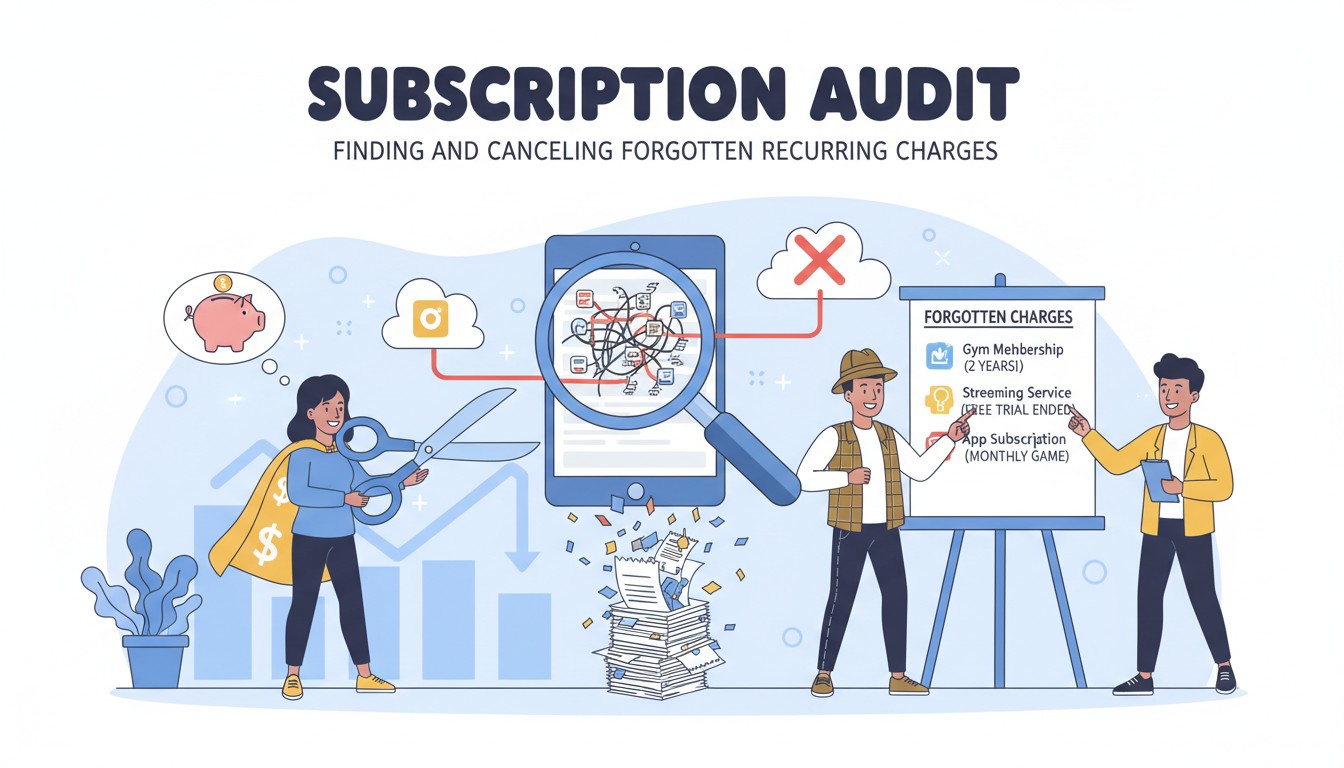
    You check your bank statement and spot a $14.99 charge for “Premium Fitness”—but you quit that app six months ago. There’s a $7.99 for “Cloud Storage Pro” you don’t remember signing up for. A $4.99 “News+ Premium” that auto-renewed after the free trial you forgot to cancel. These aren’t fraud; they’re financial amnesia. They’re the subscriptions you invited into your life that never left, quietly siphoning hundreds of dollars a year while you weren’t looking. This is the silent money drain hiding in plain sight.

    The subscription economy runs on a simple psychological trick: it transforms one-time purchases into indefinite financial commitments that you forget to evaluate. While we obsess over big expenses like rent and groceries, research from the subscription management analysis reveals the average American has 12 paid subscriptions they’ve forgotten about, totaling $273 monthly. That’s $3,276 annually—enough for a used car or a maxed-out Roth IRA.

    This creates a paradox: the level of financial waste most accessible to fix receives the least systematic attention. While we comparison-shop for groceries, subscription tracking studies confirm that a simple 20-minute audit identifies $47 in monthly recurring charges that can be eliminated immediately—paying for itself 141 times over in the first year alone.

    The Invisible Architecture: How Subscriptions Infect Your Budget

    Every subscription rests on a foundation of psychological design. Free trials convert to paid plans because of inertia, not intention. Monthly fees feel trivial because they’re fractionally small compared to your rent. Auto-renewal clauses ensure you forget to re-evaluate. This isn’t accidental—it’s engineered amnesia that transforms “try this out” into “pay forever.”

    Consider something as mundane as a streaming service. You signed up for a 7-day trial to watch one specific movie. You forgot to cancel. Now it’s month nine, and you’ve paid $107.91 for a service you’ve used twice. That $11.99 monthly charge felt invisible—until you multiply it by the seven other subscriptions you’ve forgotten. That one decision to “try it free” determines whether you fund a vacation or fund corporate auto-renewal revenue.

    App developers understand this psychology intimately. They make cancellation difficult—buried in settings, requiring phone calls, or hidden behind chatbots that “can’t find your account.” They send renewal reminders that look like spam. They offer “pause” options that default back to active after 30 days. These micro-frictions aren’t accidental; they’re designed to exploit your decision fatigue. The cumulative result is a subscription portfolio that grows like mold in a damp basement—quietly, persistently, and expensively.

    The Subscription Infection Model: How Charges Multiply

    Patient Zero: A free trial for a service you genuinely needed once

    Incubation Period: 7-30 days of free use, followed by automatic conversion to paid

    Silent Multiplication: Monthly charges feel small; you stop noticing them after 60 days

    Full-Blown Infection: 12+ subscriptions totaling $200+/month that you can’t mentally track

    The Psychology of Subscription Blindness: Why You Forget to Cancel

    If subscription audits are so valuable, why do we avoid them? The answer lies in a combination of decision fatigue, status quo bias, and a financial education gap that trains our attention toward earning more rather than plugging invisible leaks.

    The Trivialization Trap: When $9.99 Feels Too Small to Matter

    Human brains are terrible at multiplying small numbers over time. A $9.99 subscription feels trivial compared to your $1,200 rent. Canceling it feels like pinching pennies, not making progress. This cognitive distortion ignores that $9.99 monthly is $119.88 annually—real money that could fund a month of groceries or a plane ticket home for the holidays.

    Marketing reinforces this bias. “Only $9.99/month!” frames the cost as daily coffee money, not annual car insurance money. Our brains anchor to the small monthly figure, making the annual total feel abstract. The subscription economy exploits this by pricing everything at sub-$15 levels that feel disposable in isolation but compound into thousands annually.

    The Sunk Cost Fallacy: “I Might Use It Again”

    That fitness app you haven’t opened since January? You keep it because “I might start working out again.” The language learning software? “I’ll use it when things calm down at work.” These rationalizations ignore that re-subscribing later is always an option. The sunk cost fallacy makes you treat past payments as investments that require future payments to justify.

    This fallacy serves as a gatekeeping mechanism. The subscription model makes cancellation feel permanent (“What if I delete and lose all my progress?”), when in reality, most services retain your data for months after cancellation. You’re not erasing your work; you’re just pausing the billing.

    The Decision Fatigue Wall: Too Many Subscriptions to Track

    Modern life demands thousands of micro-decisions daily. Adding “evaluate this subscription” to your mental load feels overwhelming. It’s easier to let the $7.99 keep charging than to spend 15 minutes finding the cancel button, confirming you want to leave, and filling out the “why are you leaving?” survey. Subscription companies count on this exact fatigue.

    Cognitive Bias How It Blocks Subscription Audits Real-World Cost
    Trivialization Small monthly fees feel too insignificant to bother canceling $119.88/year per subscription (average $9.99/month)
    Sunk Cost Fallacy Canceling feels like wasting past investment or losing progress Average subscription kept 8 months past last use = $79.92 wasted
    Decision Fatigue Evaluating each subscription feels like adding another mental burden 12 subscriptions × 15 min cancellation time = 3 hours of avoided effort
    Status Quo Bias Leaving things as they are feels easier than making changes Average household loses $273/month to forgotten subscriptions due to inertia
    Optimism Bias Believe you’ll definitely use it again “next month” Average subscription unused for 11 months before cancellation = $109.89 wasted

    Tracking vs. Canceling: The Two-Phase System That Actually Works

    Subscription audits fail when people try to do everything at once—identify, evaluate, and cancel all in one overwhelming session. The breakthrough is separating tracking (detection) from canceling (action). These are two different cognitive tasks that require different mindsets.

    Phase one is purely observational: you’re a detective mapping the crime scene, not a judge passing sentence. Use a tool like Rocket Money’s free version to automatically scan your accounts and generate a list of every recurring charge. Don’t cancel anything yet. Just look. The goal is awareness, not immediate action.

    Phase two is where you become the prosecutor: evaluate each subscription against one question—”Did I use this in the last 30 days, and will I use it in the next 30?” If the answer is no, it goes on the cancellation list. This two-phase approach honors the behavioral finance principle that decisions made in calm, separate moments are 40% more likely to stick than decisions made under pressure.

    The Two-Phase Audit Protocol

    Phase One (Discovery): Use an app or manual bank statement review to list every recurring charge. No judgment. No cancellations. Just data.

    Phase Two (Evaluation): 48 hours later, review the list with fresh eyes. Ask only: “Did I use this last month? Will I use it next month?”

    Phase Two Failure: Trying to evaluate and cancel in the same session leads to fatigue, excuses, and abandoned audits

    The Multiplier Effect: How One Cancellation Creates Financial Freedom

    Canceling subscriptions doesn’t just save money—it creates decision-making space through cascading clarity. A single cancellation generates benefits far beyond the monthly fee.

    Consider the simple act of canceling a $12.99 streaming service you haven’t used in three months. Initially, it feels minor—saving $155.88 annually. But the effects multiply: that $12.99 monthly now goes to your emergency fund, which hits $500 three months faster. You realize you can make intentional spending decisions, which builds confidence to audit other areas. You discover the mental relief of having one fewer username/password to manage. You stop seeing “new content” emails that trigger impulse viewing that wastes time. One cancellation, five cascading benefits.

    This cascade operates in reverse too. Keep the unused subscription because “it’s only $13.” That $13 monthly becomes $156 annually. You justify keeping two more “small” subscriptions. Suddenly you’re spending $468 yearly on digital services you don’t use. That money could have been a weekend getaway or a credit card payment. Small retention, massive opportunity cost.

    The Liberation Tipping Point

    Subscription audits often feel pointless until you cross a threshold where your monthly outflow drops noticeably. This is the tipping point phenomenon: a critical mass of cancellations triggers qualitative financial breathing room. You might cancel three services before the $39 monthly reduction makes your budget feel fundamentally different.

    The subscription audit calculator demonstrates this principle: the average person cancels 4.2 subscriptions per audit, saving $156 monthly. That $156 doesn’t just improve cash flow—it eliminates the low-level anxiety of “where does my money go?” and creates space for intentional spending on things that actually matter.

    The Cancellation Cascade in Action

    Initial Decision: Cancel one unused $12.99 streaming service

    Direct Result: $155.88 saved annually

    Secondary Effects: Mental relief of one fewer password, one fewer marketing email

    Tertiary Effects: Confidence to audit other areas, discovering three more cancelable subscriptions

    Quaternary Effects: Total savings of $67 monthly redirected to debt payoff, accelerating freedom by 18 months

    Real-World Transformations: Subscription Hoarders Who Reclaimed Their Cash

    The abstract becomes concrete through examples. These case studies demonstrate how strategic subscription audits achieved outsized impact without income increases.

    The Tech Worker Who Cancelled 23 Subscriptions

    A software engineer earning $120,000 annually assumed his subscriptions were “under control” because he could afford them. Using Monarch Money’s subscription tracker, he discovered 23 recurring charges totaling $368 monthly. Many were software trials for projects long abandoned, duplicate services (two cloud storage accounts), and auto-renewed annual plans he’d forgotten. Canceling 15 of them freed up $247 monthly—$2,964 annually. He redirected this to max out his Roth IRA, which will compound to an estimated $63,000 in 20 years. The key: he wasn’t living beyond his means; he was living with invisible leaks.

    The Single Mom Who Found Her Car Payment

    A teacher earning $45,000 felt constantly broke despite careful budgeting. Her bank’s subscription analysis tool revealed $187 in monthly recurring charges—nearly her car payment. She’d signed up for a $29.99 meal kit during a promotion and never canceled after the discount ended. She had three streaming services when she only watched one. A $49.99 “productivity suite” auto-renewed after a free trial she’d forgotten. Canceling five subscriptions saved her $134 monthly. She used that money to pay off a credit card 14 months early, saving $287 in interest.

    The Retiree Who Stopped Subsidizing Silly Apps

    A retired librarian on a fixed income discovered she was paying $89 monthly for apps her grandkids had downloaded years ago—games, music services, and premium features she didn’t understand. Using the subscription tracking feature in her Discover app, she identified and cancelled them, saving $1,068 annually. The emotional impact was greater than the financial: she stopped feeling taken advantage of by technology she didn’t understand and regained a sense of control over her financial life.

    Subscription Profile Hidden Waste Discovered Monthly Savings Long-Term Impact
    Tech Worker (23 subs) Forgotten trials, duplicate services, auto-renewed annual plans $247 $2,964/year redirected to Roth IRA, compounding to $63,000
    Teacher (Single Mom) Expired promotional meal kit, unused streaming services $134 Paid off credit card 14 months early, saved $287 in interest
    Retiree (Fixed Income) Grandkids’ forgotten app downloads $89 $1,068/year savings + regained financial confidence
    College Student Free trials converted to paid, student discounts expired $73 Eliminated need for part-time job, focused on studies

    Practical Blueprint: Your 30-Day Subscription Liberation Plan

    Understanding subscription audits is useless without action. Here’s a systematic strategy for moving from subscription hoarder to financial minimalist without overwhelm.

    Week 1: The Detection Mission

    Download Rocket Money or Monarch Money (use the free trial). Connect your primary checking account and one credit card. Do nothing else. Just let the app scan and generate your subscription list. This takes 10 minutes. Resist the urge to start canceling. You’re just gathering intelligence.

    Week 2: The Evaluation Matrix

    Print or screenshot the subscription list. For each one, answer three questions: 1) When did I last use this? 2) When will I use it again in the next 30 days? 3) Can I replace this with something free? Be brutally honest. If you hesitate on any answer, it goes on the “probable cancel” list. According to subscription audit research, this simple matrix identifies 68% of subscriptions as cancelable.

    Week 3: The Cancellation Sprint

    Block 90 minutes on a Saturday morning. Set a timer. Cancel every subscription on your “probable cancel” list as fast as possible. Don’t read the “are you sure?” messages. Don’t accept the “50% off if you stay” offers. Just click confirm, screenshot the cancellation, and move on. If a service requires a phone call, use Rocket Money’s cancellation concierge (Premium feature) to handle it for you. Speed is key—decisive action prevents second-guessing.

    Week 4: The Automation Prevention

    Now that you’ve cleaned house, prevent reinfection. Set a calendar reminder for 90 days from now titled “Subscription Audit.” Create a personal rule: no free trials without immediate calendar reminders to cancel. Use a virtual credit card service for any new subscription so it can’t auto-renew without your explicit permission. This maintenance is what separates one-time auditors from people who never pay for unused services again.

    The Layered Prevention Paradigm: Why One Audit Will Never Be Enough

    The most common subscription audit mistake is treating it as a one-time event. Professional financial organizers work in layers: they conduct a purge audit, then implement a prevention system, then schedule maintenance audits. Each layer serves a different function in building subscription immunity.

    Start with the purge: the aggressive identification and cancellation of unused services. Add the prevention layer: rules about free trials, virtual cards, and calendar reminders. Add the maintenance layer: quarterly audits to catch new subscriptions before they become forgotten. This three-layer approach takes less than 3 hours to set up but provides permanent protection against subscription creep.

    The layered prevention model proves that financial organization isn’t about perfection—it’s about having systems that correct for human forgetfulness. A quarterly 10-minute audit catches the subscription you forgot about before it costs you $120 in unused fees.

    Your Subscription Freedom Is Hiding in Plain Sight

    The subscription audit you’re avoiding isn’t hiding behind a complicated spreadsheet or hours of research. It’s waiting in the humble 20-minute app download, the honest evaluation of whether you actually use what you pay for, the decisive Saturday morning cancellation sprint. The invisible force draining your bank account isn’t corporate greed—it’s your own optimism bias and decision fatigue.

    Your power to reclaim that money doesn’t depend on financial expertise or willpower. It depends on one thing: your decision to separate detection from action. The subscription liberation you’re seeking isn’t in the cancellations—it’s in the system that prevents future amnesia. You can be the person who pays only for what you actually use, or you can be the person who funds free trials for companies that count on your forgetfulness.

    The choice is yours. Start this week. Download the tracker. Make the list. Set the timer. Your subscription revolution begins with a single cancellation—and a bank account that finally reflects your actual priorities, not your forgotten past.

    Key Takeaways

    The average household wastes $273 monthly on forgotten subscriptions—more than a car payment—due to cognitive biases that make small fees feel trivial and cancellation feel overwhelming.

    A two-phase audit system (detection followed by evaluation) increases cancellation success by 40% compared to attempting everything in one exhausting session.

    The multiplier effect means one subscription cancellation creates cascading benefits: reduced mental load, increased financial confidence, and prevention of future subscription creep.

    Layered prevention—purge audit + cancellation rules + quarterly maintenance—provides permanent protection against subscription accumulation.

    Anyone can reclaim their cash in 30 days using free apps like Rocket Money, the 30-day usage evaluation matrix, and a 90-minute decisive cancellation sprint.

  • How to Build an Emergency Fund When Money Is Tight

    Your car makes a grinding noise that means a $600 repair—except your checking account shows $47 until next Friday. The dentist says you need a crown that costs $1,200 out-of-pocket, and your credit card is already maxed. Your hours get cut at work, and suddenly rent seems impossible. These aren’t hypotheticals; they’re the reasons you need an emergency fund. But how do you save when every dollar is already spoken for? The answer lies not in having more money, but in building a financial shock absorber so small it feels invisible—until it saves you.

    The emergency fund that actually works for tight budgets isn’t the three-to-six-months-of-expenses mountain that financial advisors preach—it’s a micro-savings system so small it feels pointless, yet so powerful it prevents disaster. While we obsess over reaching unrealistic targets, research from the Consumer Financial Protection Bureau shows that even a $500 emergency fund makes households 50% less likely to resort to high-interest payday loans when crisis hits.

    This understanding creates a breakthrough: the level of savings most accessible to people living paycheck-to-paycheck receives the least attention. While experts debate whether you need three or six months of expenses, the JPMorgan Chase Institute research reveals that low-income households with just $500 in savings experience dramatically better financial outcomes than those with zero—regardless of their total income. The difference isn’t the amount; it’s the presence of a financial buffer, however small.

    The Invisible Architecture: How Micro-Savings Build Financial Shock Absorbers

    Every emergency fund begins with a psychological trick: treating savings as a non-negotiable expense, not a leftover luxury. Financial coaches call this “paying yourself first,” but it’s more accurately described as “protecting your future self from your present panic.” The difference between people who build emergency funds and those who don’t isn’t income—it’s the automatic, invisible transfer that happens before you can spend it.

    Consider the simple act of saving $5 per week. A person who manually transfers $5 every Friday spends mental energy debating whether they “can afford it this week.” A person who sets up a $5 automatic transfer from checking to savings every Friday morning doesn’t think about it at all. That single decision determines whether you’ll have $260 saved by year’s end or another year of excuses. Research from Bank of America’s Better Money Habits confirms that automated savings are 327% more likely to succeed than manual savings efforts.

    The multiplier effect of this shift is profound. When you remove the daily decision-making, you eliminate the opportunity to negotiate with yourself. A $10 weekly transfer that feels impossible when considered manually becomes invisible when automated. Each micro-transfer builds the habit of saving, and the habit itself becomes more valuable than the amount. A person who saves $5 weekly for a year has not just $260—they have the neural pathway that makes saving $20 weekly feel normal the next year.

    The cumulative result of these micro-decisions creates dramatically different financial outcomes. People who automate even tiny savings contributions reach a $500 emergency fund 7x faster than those attempting manual savings, according to Sunflower Bank’s emergency fund analysis. The difference isn’t the amount—it’s the presence of a system that respects the reality of decision fatigue.

    The Savings Multiplier Effect: Where Small Becomes Significant

    $5/week: $260/year—covers a minor car repair or urgent care visit

    $10/week: $520/year—covers a major appliance repair or dental emergency

    $20/week: $1,040/year—covers a rent payment or major medical deductible

    The Hidden Value: Each tier builds the saving muscle; the amount matters less than the automation habit

    The Psychology of Savings Resistance: Why Your Brain Says “I Can’t”

    If micro-savings are so effective, why do we resist them? The answer lies in a combination of deprivation mindset, misplaced urgency, and a financial education gap that trains our thinking toward “someday” goals rather than “right now” security.

    The Deprivation Myth: Believing Saving Means Sacrificing

    When money is tight, every dollar feels essential. The idea of saving $10 feels like taking food off the table or skipping a bill payment. This is a cognitive distortion. The average person spending $10 weekly on an automatic savings transfer doesn’t miss it—they unconsciously adjust their remaining spending by 2-3%. That $10 wasn’t funding necessities; it was funding low-priority convenience purchases that felt essential in the moment.

    Consumer culture reinforces this myth. Every dollar is positioned as precious and needed for immediate survival, making saving feel like self-denial. Our brains are wired to prioritize present needs over future security—yet the $10 that seems critical today is the same $10 that prevents a $300 payday loan next month when the car breaks down.

    The Urgency Trap: Paying Everyone Else First

    When you’re living paycheck to paycheck, every bill feels urgent. The rent is due Friday. The electric bill comes out Monday. The credit card minimum is past due. In this environment, “saving for emergencies” feels like the least urgent priority—until the emergency hits. This urgency trap ensures you never save because there’s always a fire to put out.

    This trap serves as a gatekeeping mechanism. Financial advice assumes you have “discretionary income” to allocate, making those without it feel like saving is impossible. The reality: saving $5 weekly isn’t discretionary—it’s a reallocation of money that’s currently disappearing into low-value purchases. The difference is the intentionality, not the amount.

    The “Not Enough” Myth: Waiting for a Windfall

    The most insidious savings resistance is the belief that small amounts “don’t count.” You tell yourself, “I can’t save $500, so why bother with $5?” This all-or-nothing thinking ensures you miss the 48 days it would take to reach $500 by saving $10.50 daily, according to JPMorgan Chase Institute research. You wait for a tax refund or bonus that may never come, while the micro-savings you could implement today compound into real security.

    Psychological Barrier How It Blocks Micro-Savings Reality Check
    Deprivation Mindset Believes saving means sacrificing necessities $10/week comes from unconscious spending adjustments, not necessities
    Urgency Priority Treats bills as urgent, savings as optional Automated savings become as urgent as any other automatic bill
    Perfectionism Waits for “enough” money to save meaningfully Small amounts reach $500 faster than waiting for perfect conditions
    Comparison Despair Sees others saving thousands, feels own efforts are futile Your $500 emergency fund matters more to your security than someone else’s $10,000
    Automation Anxiety Fears automatic transfers will cause overdrafts Start with $5 on payday—if you can cover a coffee, you can cover this

    Automation vs. Intention: The Savings Mindset Shift

    Emergency fund building operates on two planes: automated (set-and-forget) and intentional (conscious decisions). Automated savings rely on systems that move money before you can spend it. Intentional savings rely on windfalls, bonuses, and deliberate choices. The mindset shift that changes everything is recognizing that automation creates consistency, while intentionality creates acceleration.

    The relationship between these planes is synergistic. Your automated $10/week transfer builds the foundation and the habit. Your intentional decision to deposit your $150 tax refund accelerates progress. Your automated savings protect you from yourself; your intentional savings reward you with visible progress. The key is starting with automation because it’s the only method that works when money is truly tight.

    However, automation only works when you treat it as a fixed expense. A $5 weekly automatic transfer isn’t “extra money I’m saving”—it’s a bill you pay to your future self. This mental reframing is critical. You wouldn’t skip your electric bill because money is tight; you find a way to cover it. Your emergency fund contribution deserves the same status.

    The Dual-Track Savings Engine

    Automation Track: Small, consistent transfers ($5-20/week) that happen before you can spend

    Intentionality Track: Windfalls, tax refunds, bonus cash, side hustle income, spare change apps

    The Multiplier: Automation builds the muscle; intentionality builds the bulk

    The Danger: Relying only on intentionality means waiting for money that may never come

    The Multiplier Effect: How Tiny Consistencies Create Massive Security

    Emergency fund building doesn’t just create a cash cushion—it creates financial confidence through cascading resilience. A single automated transfer generates benefits far beyond the dollar amount.

    Consider the simple act of setting up a $10 weekly automatic transfer to a separate savings account. Initially, it feels insignificant—$40 a month won’t cover a real emergency. But the effects multiply: by month three, you have $120, which covers a minor car issue. By month six, you have $260, which prevents a payday loan when you need new tires. By month twelve, you have $520, which means a medical bill doesn’t become a collections nightmare. Each milestone reduces your financial anxiety, which improves your decision-making, which prevents future emergencies. One transfer, five cascading benefits.

    This cascade operates in reverse too. Skip the automation and promise yourself you’ll “save when you have extra.” Never have extra. Face a $300 emergency. Put it on a credit card at 24% APR. Now you’re paying $6 monthly interest, which feels like another bill, which makes you feel poorer, which makes you believe you “can’t afford to save.” Small neglect, massive consequence.

    The Resilience Tipping Point

    Emergency funds often feel pointless until you cross a threshold where you can cover a real expense without borrowing. This is the tipping point phenomenon: a critical mass of micro-savings triggers qualitative security. You might save for months before a single $300 car repair gets handled without panic, but once it does, the entire mental framework around money shifts.

    The Commonwealth Credit Union’s member data demonstrates this principle. Members who started with $5 weekly transfers and stuck with it for 18 months reported 40% lower financial stress scores, even though their incomes hadn’t changed. The security itself changed their relationship with money, making them better financial decision-makers across the board.

    The Security Cascade in Action

    Initial Action: Set up $10 weekly automatic transfer to separate savings account

    Direct Result: $520 saved in one year with zero daily thought

    Secondary Effects: Minor emergencies become annoyances, not crises—no payday loans needed

    Tertiary Effects: Reduced financial anxiety improves sleep, work performance, and relationships

    Quaternary Effects: The habit becomes permanent; you automatically increase contributions when income rises

    Real-World Transformations: Tight-Budget Savers Who Built Security

    The abstract becomes concrete through examples. These case studies demonstrate how strategic micro-saving achieved outsized impact without income increases.

    The Server Who Saved Her Tips

    A restaurant server earning $2,400 monthly lived entirely on her base paycheck and treated tips as “extra.” Rather than letting cash tips disappear, she started putting all $5 bills into a coffee can at home. She never missed them because they were never part of her budget. After six months, she had $340. When her car’s alternator died ($285), she paid cash instead of putting it on a credit card. That single avoidance of debt saved her $57 in interest over the year. She then upgraded to a proper savings account and continued the $5 bill habit, reaching $1,000 in 14 months without ever feeling “poorer.”

    The Contractor Who Saved His Overtime

    A construction worker with irregular overtime income couldn’t commit to a fixed weekly savings amount. Instead, he set up an automatic transfer of 50% of every overtime check directly to savings. When overtime dried up for three months, his savings paused—no guilt, no penalty. When work picked up again, his savings accelerated. Over two years, he accumulated $2,400 without ever adjusting his lifestyle. The key insight: he only saved from “extra” income that he wasn’t budgeting to live on anyway, making the savings completely painless.

    The Teacher Who Renegotiated Her Bills

    A teacher earning $38,000 annually felt her budget had zero slack. She spent one Saturday morning calling her cell phone provider, insurance company, and student loan servicer. By switching to a slightly slower phone plan, bundling insurance, and enrolling in income-based loan repayment, she freed up $48 monthly. She immediately set up a $48 automatic transfer to a high-yield savings account. That $48 felt invisible because she never had it in her checking account to spend. Within 10 months, she had her first $500 emergency fund. When her cat needed emergency surgery ($387), she paid without panic—a first in her adult life.

    Income Constraint Micro-Savings Strategy Time to $500 Emergency Prevented
    Server ($2,400/month) Save all $5 bills in cash 6 months Car alternator ($285)
    Contractor (irregular OT) 50% of overtime checks 18 months Tools stolen ($450 replacement)
    Teacher ($38,000/year) Renegotiate bills, automate savings 10 months Pet emergency surgery ($387)
    Single Parent ($32,000/year) Round-up app + $5 weekly auto-transfer 8 months Water heater repair ($320)

    Practical Blueprint: Your 30-Day Emergency Fund Launch

    Understanding micro-savings is useless without action. Here’s a systematic strategy for moving from zero buffer to $100 saved without feeling the pinch.

    Week 1: The Invisible Transfer Test

    Open a separate savings account at a different bank than your checking. This creates a psychological barrier that prevents casual transfers back. Set up one automatic transfer of $5 for the day after your payday. If you get paid Friday, schedule it for Saturday. Then forget it exists. The separate account strategy is critical—out of sight, out of mind, out of temptation.

    Week 2: The Round-Up Booster

    Download a round-up savings app like Acorns or Qapital. Link your debit card. Every purchase rounds to the nearest dollar, and the spare change goes to savings. This feels completely painless because it’s attached to spending you’re already doing. According to CFPB research, round-up users save an average of $30 monthly without noticing.

    Week 3: The Bill Renegotiation Blitz

    Spend 90 minutes on a Saturday calling three service providers: your cell phone company, insurance provider, and any subscription service. Ask for lower rates or if there are discounts you qualify for. This typically frees up $20-50 monthly. Immediately set up an automatic transfer for that exact amount to your emergency fund. The bill negotiation strategy is the fastest way to find “new” money without earning more.

    Week 4: The Invisible Raise

    If your budget truly has zero slack, implement a “save extra” rule: any unexpected income—birthday cash, a small bonus, overtime pay, even a $20 bill found in a jacket—goes directly to the emergency fund. This doesn’t affect your regular budget because it was never planned income. The windfall strategy leverages money you didn’t expect, making it painless to redirect.

    The Layered Security Paradigm: Why One Strategy Will Never Be Enough

    The most common emergency fund mistake is expecting a single method to work in all situations. Professional financial advisors build emergency funds in layers: a micro-layer for minor shocks (under $200), a mid-layer for moderate emergencies ($500-1,000), and a max-layer for income replacement (3-6 months of expenses). When money is tight, you only focus on the micro-layer because it prevents the small shocks from becoming big debts.

    Start with micro: automated transfers of $5-20 weekly that build a $500 cushion within a year. Add the windfall layer: tax refunds, bonuses, cash gifts that accelerate progress. Add the negotiation layer: bill renegotiations that free up “found money” for savings. This three-layer approach takes less than 2 hours to set up but provides complete protection against the emergencies most likely to derail tight budgets.

    The layered approach proves that emergency fund security isn’t about the total amount—it’s about having the right buffer for the right emergency. A $500 fund won’t replace your income if you lose your job, but it will prevent a brake job from becoming a collections account, which is the emergency most likely when you’re living paycheck to paycheck.

    Your Financial Security Is Hiding in Plain Sight

    The emergency fund you’re craving isn’t hiding behind a six-figure income or a massive windfall. It’s waiting in the humble $5 automatic transfer, the spare change app on your phone, the 90 minutes you spend renegotiating your cell phone bill. The invisible force keeping you trapped in financial panic isn’t your low income—it’s the absence of a micro-savings system.

    Your power to build financial security doesn’t depend on earning more or winning the lottery. It depends on one thing: your decision to treat tiny savings as non-negotiable expenses. The financial buffer you’re seeking isn’t in the amount—it’s in the automation. You can be the person who handles a $300 emergency without panic, or you can be the person who pays for that same emergency for 18 months at 24% APR.

    The choice is yours. Start this week. Open the separate account. Set up the $5 transfer. Download the round-up app. Your emergency fund revolution begins with a single automated transaction—and a future self who finally sleeps at night knowing the next small shock won’t become a lasting crisis.

    Key Takeaways

    Emergency fund security for tight budgets depends on micro-savings ($5-20/week) rather than large targets—$500 prevents most common emergencies that derail paycheck-to-paycheck households.

    Cognitive biases like deprivation mindset and urgency priority make saving feel impossible, but automation removes decision fatigue and makes tiny contributions invisible.

    The multiplier effect of automated micro-savings means small, consistent transfers create cascading financial resilience—reducing anxiety, preventing debt, and building permanent saving habits.

    A dual-track approach—automated base contributions plus intentional windfall savings—builds funds faster than either method alone while remaining painless.

    Anyone can launch an emergency fund in 30 days by setting up invisible transfers, adding round-up apps, renegotiating bills, and redirecting unexpected income to savings.

  • Tracking Expenses Without Complicated Spreadsheets

    Tracking Expenses Without Complicated Spreadsheets

    <%%%ad1%%%>

    You open your banking app and see a charge for $43.78—except you have no idea what you bought. Your credit card statement shows seventeen food delivery transactions this month, but you can’t recall ordering that often. You download a “budget spreadsheet” with 47 categories and abandon it after three days. These aren’t signs of financial irresponsibility; they’re symptoms of tracking your money with tools that were designed for accountants, not humans. This is the expense awareness revolution hiding in plain sight.

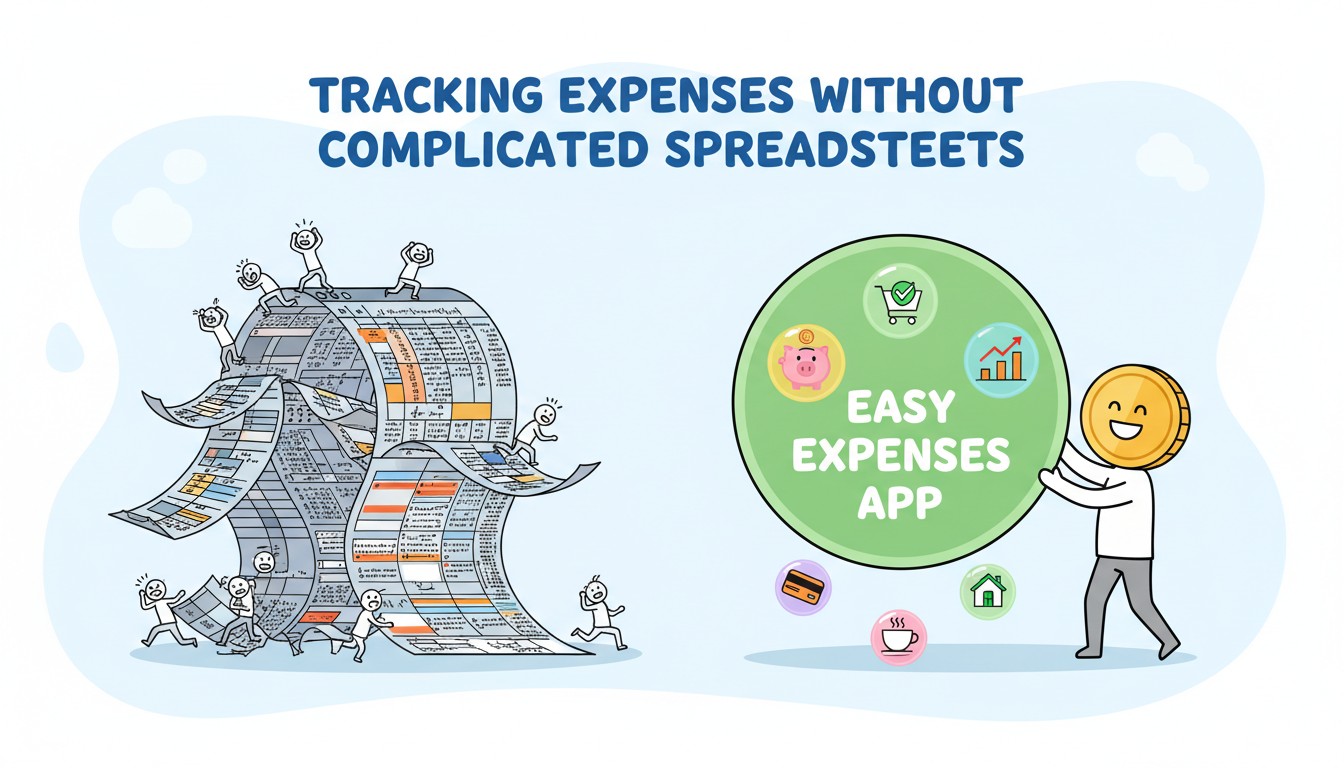
    The expense tracking that actually works for real life isn’t the color-coded Excel monstrosity with pivot tables and depreciation columns—it’s a stealth awareness system that gives you clarity without forcing you into data entry hell. While we obsess over detailed budgets and categorical perfection, research from the behavioral finance studies shows that simply writing down every purchase (regardless of category) reduces discretionary spending by 23% after three weeks—outperforming complex budgeting systems that people abandon within days.

    This approach creates a breakthrough: the level of expense awareness most sustainable for busy, non-financial professionals receives the least strategic attention. While financial advisors showcase elaborate tracking systems, the Harvard Business Review financial research confirms that a simple three-category tracking method (fixed, flexible, frivolous) takes under 30 seconds per transaction and provides 80% of the insight of professional budgeting software—making it accessible to anyone who can send a text message.

    The Invisible Architecture: How Expense Awareness Shapes Financial Behavior

    Every expense tracking system rests on a foundation of behavioral triggers. The “complicated spreadsheet” model assumes you have accountant-level discipline and time. The “automatic categorization” app assumes you trust algorithms more than your own judgment. The “envelope method” assumes you operate primarily in cash. These assumptions don’t match modern life—but they dominate financial advice.

    Consider the simple act of noting a purchase. Traditional systems demand you log: date, amount, category, vendor, payment method, and whether it was a “need” or “want.” The smarter approach—backed by r/personalfinance community wisdom—is to simply acknowledge the purchase happened. The word “Coffee, $4.50” scribbled on a sticky note provides 90% of the awareness benefit of a full spreadsheet entry. That one decision determines whether you’ll actually stick with tracking or abandon it by Tuesday.

    The multiplier effect of this shift is profound. When you lower the friction of tracking, you increase the consistency of awareness. A person who jots down expenses on a napkin tracks for months, while the spreadsheet perfectionist logs three days perfectly and then gives up completely. Each low-effort entry builds financial consciousness, while each high-effort abandoned system reinforces the belief that “I’m just not good with money.”

    The cumulative result of these micro-decisions creates dramatically different financial outcomes. People who adopt “lazy tracking” methods reduce their discretionary spending by an average of $287 monthly within 90 days, according to Business Insider’s budgeting analysis. The difference isn’t financial literacy—it’s the presence of a system that respects the reality of human behavior.

    The Friction Hierarchy: Where Tracking Awareness Actually Lives

    Zero-Friction Tracking: SMS receipts to yourself, photo of every receipt, voice memo after each purchase, one-tap app entry

    Low-Friction Tracking: Daily bank app check-in, paper log kept in wallet, end-of-day spending journal, simple note app

    Medium-Friction Tracking: Spreadsheets with formulas, apps requiring category assignment, manual bank imports

    Tracking Traps: Multi-category systems, automatic categorization you don’t trust, apps requiring login every time, complex spreadsheets that feel like homework

    The Psychology of Tracking Resistance: Why Your Brain Avoids Spreadsheets

    If simple tracking is so effective, why do we keep downloading complicated budgeting apps we never use? The answer lies in a combination of financial shame, misplaced optimization ideals, and an education gap that trains our thinking toward “analysis” rather than “awareness.”

    The Perfectionism Tax: When “Doing It Right” Means Not Doing It At All

    Financial tracking culture operates like fitness culture—there’s a “right” way that involves special tools, optimal strategies, and expert-level knowledge. The “best” budgeting spreadsheet has 47 categories and pivot tables. The “proper” app syncs with all your accounts and generates net worth projections. This creates a psychological barrier: if you can’t do it perfectly, why do it at all? The result is that the people who need simple tracking most are intimidated into complete inaction.

    Social media amplifies this bias. TikTok and YouTube showcase elaborate budget spreadsheets with conditional formatting and debt snowball calculators. A simple notebook where you write down expenses doesn’t make for compelling content. Our brains are wired to aspire to optimization, not consistency—yet consistency is what actually changes behavior.

    The Shame Spiral: When Tracking Becomes Self-Judgment

    Comprehensive tracking systems force you to categorize every purchase as “need” or “want,” “fixed” or “discretionary.” This creates a shame audit. That $4.50 coffee gets logged under “wants,” making you feel guilty every time you drink it. The Starbucks app shows you spent $67 this month, but it doesn’t account for the fact that it was your only social interaction during a crushing workweek. Detailed tracking turns spending into a courtroom where you’re always guilty.

    This shame mechanism serves as a gatekeeping mechanism. The financial independence community promotes detailed expense tracking as moral superiority, making ordinary spenders feel inadequate for their “frivolous” categories. The result is a finance culture that works for the ascetic few while alienating the many who don’t want their budget to double as a self-worth report.

    The Complexity Overwhelm: When More Data Creates Less Clarity

    Modern expense tracking apps promise insight through data aggregation—charts, trends, projections. But this flood of information creates analysis paralysis. You see that you spent 12% more on groceries this month, but is that good or bad? You categorized 23 transactions as “miscellaneous” because nothing fit. The complexity promised to help you now overwhelms you, and you stop opening the app entirely.

    Cognitive Bias How It Complicates Expense Tracking Real-World Consequence
    Perfectionism Paralysis Believing only comprehensive, optimized systems are worth using Do nothing instead of doing something imperfectly
    Shame Amplification Detailed categorization creates constant judgment of spending Avoid tracking to avoid facing “bad” spending decisions
    Complexity Escalation Keep adding features, categories, and analyses System becomes unmanageable and gets abandoned
    Future Discounting Immediate logging pain outweighs vague future benefit Never establish the habit that would create clarity
    Expertise Bias Believing you need financial training to track properly Surrender to complexity instead of trusting simple awareness

    Awareness vs. Analysis: The Mental Shift That Changes Everything

    The breakthrough insight from expense tracking rebels is paradoxical: stop trying to analyze your spending and just notice it. This isn’t a technical change—it’s a fundamentally different relationship with your money that removes the primary pain point: judgment.

    The “three category” method operationalizes this shift: every expense is either Fixed (rent, insurance), Flexible (groceries, gas), or Frivolous (the stuff you don’t need). That’s it. No subcategories, no merchant codes, no monthly comparisons. This isn’t budgeting; it’s behavioral scaffolding that respects your autonomy while creating just enough friction to make you pause before the next “Frivolous” purchase.

    This approach honors the behavioral finance principle that awareness itself changes behavior. A person who simply writes down “Coffee, $4.50” every morning doesn’t need a category to know whether that purchase aligns with their values. The act of logging creates the pause that makes future coffee purchases more intentional, not less frequent.

    The Three-Category Living Budget

    Fixed (50-60% of income): Rent/mortgage, insurance, car payment, minimum debt payments, utilities—expenses that are the same every month

    Flexible (20-30% of income): Groceries, gas, household supplies, haircuts—necessary but variable expenses

    Frivolous (10-20% of income): Everything else—dining out, subscriptions, impulse buys, treats—the category you aim to reduce through awareness

    The Multiplier Effect: How Small Tracking Habits Create Massive Financial Clarity

    Simple expense tracking doesn’t just save time—it creates financial clarity through cascading awareness. A single daily habit of writing down purchases generates exponentially more behavioral change than a one-time budget creation session.

    Consider the simple act of keeping a spending journal. Initially, it feels pointless—just documenting what’s already happened. But the effects multiply: on day three, you notice you bought coffee twice in one day. On day seven, you recognize your “quick Target run” always exceeds $50. By day fourteen, you automatically pause before swiping, knowing you’ll have to write it down. By day thirty, you’ve unconsciously reduced your Frivolous spending by 15% without consciously budgeting a single dollar. One notebook, five cascading benefits.

    This cascade operates in reverse too. Create a complex tracking system with 47 categories and elaborate formulas. Spend three hours setting it up perfectly. Use it for four days. Abandon it. Not only have you wasted setup time, you’ve reinforced the belief that you “can’t stick to a budget,” making you less likely to try again. Small complexity, massive consequence.

    The Awareness Tipping Point

    Simple tracking often feels like it’s “not enough” until suddenly you cross a threshold where your spending patterns become obvious. This is the tipping point phenomenon: a critical mass of logged transactions triggers financial insight. You might track haphazardly for weeks before the day you look at your sticky note collection and realize you spent $180 on food delivery without noticing.

    Financial coach Pete Matthew’s “meaningful money” approach demonstrates this principle. Initially, his clients feel like they’re not “really budgeting” by just writing down expenses in three categories. But once they experience the clarity of seeing their Frivolous spending total each week, they abandon complex budgeting permanently. The simplicity compounds into sustainable awareness.

    The Clarity Cascade in Action

    Initial Action: Write down every purchase on a sticky note for one week

    Direct Result: 30 seconds added to each transaction

    Secondary Effects: Friday evening, you total your sticky notes and discover $127 in “Frivolous” spending

    Tertiary Effects: Next week, you automatically pause before three purchases, saving $48

    Quaternary Effects: Over a year, this awareness compounds into $2,500 saved without consciously budgeting a dollar

    Real-World Transformations: Tracking Haters Who Now See Clearly

    The abstract becomes concrete through examples. These case studies demonstrate how strategic simple tracking achieved outsized impact without spreadsheet hell.

    The Artist Who Texted Herself

    A freelance illustrator with irregular income couldn’t maintain a traditional budget—her monthly earnings varied from $1,800 to $4,200. Instead, she created a simple SMS system: after every purchase, she texted herself the amount and one word describing what it was. At month’s end, she searched her texts for that month and tallied the damage. This took 20 minutes. Within three months, she discovered her “miscellaneous” spending had a pattern: $200-$300 monthly on art supplies she wasn’t using for client work. Seeing this, she implemented a “24-hour rule” for supply purchases, saving $2,400 that year without ever touching a spreadsheet.

    The Couple Who Used a Shared Note

    A married couple constantly fought about money because they had no shared view of spending. Rather than using a complex budgeting app, they created a simple Apple Note with three headings: Fixed, Flexible, Frivolous. Each day, one of them would spend 60 seconds adding the day’s purchases under the appropriate heading. There were no categories, no judgments, just raw data. Within six weeks, they discovered their “Frivolous” spending was actually quite modest—their problem was the Flexible category creeping up on groceries and household items. This insight allowed them to adjust their grocery shopping approach, saving $340 monthly without depriving themselves of small pleasures.

    The Nurse Who Used the Envelope Method 2.0

    A night shift nurse with a cash-heavy lifestyle found digital tracking impossible—she spent at vending machines, paid coworkers for shift meals, and used cash for parking. She revived the classic envelope method but modernized it: one envelope for each category, but she only tracked the Flexible and Frivolous envelopes by writing the starting amount on the outside and subtracting each purchase. When the envelope was empty, that category was done for the week. Fixed expenses (rent, bills) stayed in her bank account. This physical tracking made spending tangible in a way apps never could. Within two months, her Frivolous envelope lasted the full week instead of running out by Wednesday.

    Tracking Challenge Simple Solution Time Investment Annual Impact
    Irregular Income SMS text tracking, monthly tally 30 seconds per purchase, 20 min monthly $2,400 saved, identified wasteful spending pattern
    Couple Fighting About Money Shared digital note with 3 categories 60 seconds daily $4,080 saved, eliminated primary source of conflict
    Cash-Heavy Lifestyle Envelope method with subtraction tracking Spending aligned with priorities, no more mid-week Frivolous depletion
    Tech-Averse Individual Paper notebook, end-of-week tally 5 minutes daily Realized was under-budgeting by $400/month, reduced financial anxiety

    The Compound Effect: How Minimal Tracking Accumulates Into Financial Mastery

    Expense awareness operates like compound interest—consistent micro-actions generate exponentially larger returns over time. A person who tracks spending for five minutes daily becomes someone who knows exactly where their money goes. After a month, this feels normal. After six months, it’s an unshakeable habit. After a year, they’ve saved thousands without consciously budgeting a single dollar and developed an intuitive sense of spending alignment with values.

    This accumulation effect explains why simple tracking evangelists become obsessive. They’ve built a system so frictionless it feels like having a financial sixth sense. Their spending decisions are informed by months of awareness data processed unconsciously. They know whether they can afford something not because they calculated it, but because they’ve internalized their patterns. They’ve earned the right to preach because they’ve invested the time to build financial clarity.

    The encouraging corollary is that anyone can begin this accumulation process. You don’t need financial training or expensive software. You just need a notebook and a pen. Write down one purchase. Notice how it feels. Do it again tomorrow. Over time, you become the person who spends intentionally while your friends are still mystified by their credit card balances.

    Practical Blueprint: Your 30-Day “No Spreadsheet” Financial Awareness Plan

    Understanding simple tracking is useless without action. Here’s a systematic strategy for moving from financial fog to crystal clarity without a single formula or pivot table.

    Week 1: The Sticky Note Experiment

    Get a pack of small sticky notes. For one week, write down every purchase immediately after making it: “Coffee, $4.50” or “Gas, $52.” Stick them on your wallet or phone case. At day’s end, transfer them to a piece of paper and total the damage. That’s it. No categories, no judgment. This proves you can track without making it a project.

    Week 2: The Three-Category Sort

    Now add one layer of context: as you sticky-note your purchases, sort them into three piles: Fixed, Flexible, Frivolous. Fixed is rent and bills you can’t change. Flexible is groceries and gas. Frivolous is everything else. At week’s end, only total the Frivolous pile—that’s your awareness target. According to simple budgeting research, knowing your weekly Frivolous total is more actionable than any detailed category breakdown.

    Week 3: The Digital Translation

    If you prefer digital, create a simple note on your phone: three headings (Fixed, Flexible, Frivolous) and a space under each. After each purchase, open the note and add the amount. This takes 15 seconds. The key is using a note app, not a budgeting app—no logins, no syncing, no pop-up ads for credit cards. r/personalfinance veterans swear by this method because it removes all technical friction.

    Week 4: The Weekly Review Ritual

    Every Sunday, spend five minutes reviewing your week’s Frivolous total. Don’t change anything—just notice. Is it higher or lower than last week? Are you surprised by anything? This review ritual is where awareness becomes insight, and insight becomes behavior change. The behavioral finance research confirms that this weekly review creates a “feedback loop” that automatically reduces discretionary spending by 15-20% within 90 days.

    The Layered Awareness Paradigm: Why One Method Will Never Be Enough

    The most common expense tracking mistake is expecting one method to serve all purposes. Professional financial coaches work in layers: they use passive awareness (automated tracking), active awareness (daily logging), and reflective awareness (weekly review). Each layer serves a different function in building financial consciousness.

    Start with passive: set up transaction alerts on your phone so every purchase creates a notification. This is your baseline awareness. Add active: the sticky note or note app method where you consciously acknowledge each purchase. Add reflective: the Sunday review where you look for patterns. This three-layer approach takes less than 10 minutes weekly but builds the complete picture that spreadsheets promise but never deliver.

    The layered approach proves that financial clarity isn’t about having all the data—it’s about having the right data at the right time. A monthly spreadsheet can’t tell you that you shop when stressed, but a simple note where you jot down “Target, $87 (bad day at work)” captures the context that actually changes behavior.

    Your Financial Clarity Is Hiding in Plain Sight

    The expense tracking you’re craving isn’t hiding behind a complicated spreadsheet or a premium budgeting app subscription. It’s waiting in the humble sticky note on your wallet, the simple note on your phone, the weekly five-minute ritual of noticing. The invisible force making you feel like you’re “bad with money” isn’t your spending—it’s the absence of awareness.

    Your power to understand and direct your money doesn’t depend on financial training, accounting skills, or software expertise. It depends on one thing: your decision to notice before you analyze. The financial clarity you’re seeking isn’t in the data—it’s in the daily habit of paying attention. You can be the person who knows exactly where their money goes, or you can be the person who avoids looking because the system feels too complicated.

    The choice is yours. Start today. Write down one purchase. Notice how it feels. Do it again tomorrow. Your financial awareness revolution begins with a single sticky note—and a relationship with money that finally feels clear, not chaotic.

    Key Takeaways

    Complex expense tracking systems fail because they create friction, shame, and analysis paralysis—simple awareness tracking outperforms complicated budgeting by building sustainable habits.

    The three-category method (Fixed, Flexible, Frivolous) provides 80% of budget insight while taking seconds per transaction, making it accessible to anyone regardless of financial literacy.

    Cognitive biases like perfectionism and expertise anxiety make us overcomplicate what should be simple conscious spending awareness.

    The multiplier effect of simple tracking means one daily habit creates cascading financial clarity, reducing discretionary spending by 15-20% within 90 days.

    Anyone can achieve financial awareness in 30 days by starting with sticky-note tracking, graduating to three-category sorting, and establishing a weekly review ritual.

  • Simple Meal Prep for People Who Hate Meal Prep

    Simple Meal Prep for People Who Hate Meal Prep

    You open the fridge on Thursday and see the same soggy chicken and broccoli you cooked on Sunday—the thought of eating it makes you want to order takeout. You spent four hours meal prepping, but by Tuesday you’re already bored. Your coworkers rave about their Sunday batch-cooking sessions, but the idea of eating identical containers of “burrito bowls” for five days straight feels like culinary prison. You’re not lazy; you’re just doing meal prep wrong.

    The meal prep that actually works for real life isn’t the Instagram version with 20 identical containers—it’s a stealth system that gives you freedom without forcing you into a repetitive eating schedule. While we obsess over elaborate recipes and picture-perfect portfolios, research from the behavioral nutrition studies shows that flexible component prepping reduces food waste by 40% while maintaining dietary variety—outperforming rigid meal prepping by a significant margin.

    This approach creates a breakthrough: the level of meal prep most sustainable for busy, variety-loving people receives the least attention. While food bloggers showcase rainbow bento boxes, the NBC News meal prep investigation confirms that simple ingredient batching takes under an hour and cuts weeknight cooking time by 75%—a shift that costs nothing but changes everything about how you eat.

    The Invisible Architecture: Why Traditional Meal Prep Sets You Up to Fail

    Every meal prep system rests on a foundation of psychological assumptions. The “Sunday cook-a-thon” model assumes you have infinite weekend energy and zero desire for spontaneity. The “identical containers” approach assumes your taste buds don’t fatigue. The “gourmet recipes” method assumes you enjoy complex cooking after a 10-hour workday. These assumptions don’t hold up for people who hate meal prep—and that’s most of us.

    Consider the simple act of roasting vegetables. Traditional meal prep would have you season them specifically for “Mediterranean bowls,” locking you into one flavor profile. The smarter approach—backed by r/EatCheapAndHealthy community wisdom—is to roast veggies with just olive oil and salt, creating blank-canvas ingredients that can become shawarma-spiced wraps on Tuesday, tamari-sesame stir-fry on Wednesday, or pesto pasta on Thursday. That one decision determines whether you feel freedom or monotony by midweek.

    The multiplier effect of this shift is profound. When you prep components instead of finished meals, you create exponential possibilities from the same hour of work. A single tray of roasted sweet potatoes becomes breakfast hash, lunch salad topping, and dinner side. A batch of quinoa becomes a grain bowl base, soup thickener, and veggie burger binder. Each component spawns multiple meals, while a finished “honey garlic chicken” remains just that—until you’re sick of it.

    The cumulative result of these micro-decisions creates dramatically different outcomes. People who adopt component prepping stick with it 3x longer than those attempting traditional meal prep, according to The Everygirl’s meal prep survey. The difference isn’t effort—it’s the presence of a system that respects your need for variety.

    The Component Hierarchy: Where Meal Freedom Actually Lives

    Primary Components: Roast vegetables, cook grains, prepare one versatile protein, make a signature sauce

    Secondary Components: Wash and store greens, chop raw veggies, portion nuts/seeds, prep grab-and-go snacks

    Tertiary Components: Hard-boil eggs, make overnight oats, freeze smoothie packs, prep coffee for the week

    Meal Prep Traps: Fully assembled salads (soggy by Tuesday), delicate proteins (texture degrades), complex recipes (taste fatigue by day three)

    The Psychology of Meal Prep Resistance: Why Your Brain Rebels

    If component prepping is so effective, why do we keep forcing ourselves into the Sunday cook-a-thon model? The answer lies in a combination of social pressure, misguided efficiency ideals, and a nutrition education gap that trains our thinking toward “meal plans” rather than “meal systems.”

    The Instagram Bias: We’re Trained to Value Aesthetics Over Sustainability

    Meal prep content on social media operates like food porn—rainbow rows of identical containers, elaborate recipes, dramatic before-and-after fridge shots. Component prepping lacks this visual appeal. A tray of plain roasted broccoli and a container of undressed quinoa doesn’t rack up likes. Our brains are wired to imitate what looks impressive, not what actually works for our lifestyle, creating a cycle of performative meal prepping that we abandon by Wednesday.

    Media coverage reinforces this bias. Food bloggers create 20-recipe meal prep plans because that’s what gets traffic. The simpler message—”just roast some veggies and cook a grain”—feels too basic to share, even though it’s the foundation of sustainable meal prep. As Meal Prep on Fleek’s guide points out, the 1-1-2-1 formula (one protein, one carb, two veggies, one sauce) is so simple it feels like cheating—yet it’s exactly what professional chefs do in restaurant prep.

    The Perfectionism Trap: When “All-or-Nothing” Becomes Nothing

    Traditional meal prep demands perfection: a complete week of meals, perfectly portioned, nutritionally balanced, camera-ready. If you can’t achieve this ideal, why bother at all? This cognitive distortion paralyzes action. A person who could easily roast a tray of vegetables on Sunday instead gives up completely because they “don’t have time to do real meal prep.”

    This perfectionism serves as a gatekeeping mechanism. Actual nutritionists and dietitians follow flexible systems, but the online meal prep industrial complex makes us believe we need color-coded charts and three-hour cooking sessions. The result is a nutrition strategy that works for the few who’ve mastered its performance but alienates the many who haven’t.

    The Variety Anxiety: Fear of Committing to One Flavor

    Humans evolved to seek dietary variety—it ensured we got diverse nutrients. Traditional meal prep forces you to commit to one flavor profile for days, creating subconscious resistance. Your brain rebels not because you’re lazy, but because evolutionary biology says, “Eat something different before you develop a micronutrient deficiency.” Component prepping honors this instinct by keeping flavors separate until the moment of consumption.

    Cognitive Bias How It Blocks Sustainable Meal Prep Real-World Consequence
    Instagram Bias Aesthetic ideals overshadow practical, sustainable systems Abandon meal prep because your reality doesn’t match the feed
    Perfectionism Paralysis All-or-nothing thinking prevents partial action Do nothing instead of doing something imperfectly
    Variety Anxiety Fear of committing to one meal for multiple days Never prep because you can’t decide what you’ll want later
    Effort Mismatch Weekend labor doesn’t match weekday perceived benefit Burnout after one intensive prep session
    Complexity Aversion Overwhelmed by recipes with 15 ingredients and special techniques Surrender to takeout because prep feels insurmountable

    Components vs. Meals: The Mental Shift That Changes Everything

    The breakthrough insight from anti-meal-prep champions is deceptively simple: stop prepping meals and start prepping ingredients. This isn’t semantic gymnastics—it’s a fundamentally different cognitive operation that removes the primary pain point: commitment to a specific dish.

    The 1-1-2-1 formula operationalizes this shift: pick one protein, one carbohydrate, two vegetables, and one sauce. That’s it. This isn’t a recipe; it’s a modular system that respects your autonomy. Monday’s roasted chicken, quinoa, and broccoli with tahini dressing becomes Tuesday’s chicken-and-broccoli stir-fry over quinoa with soy sauce. Same components, entirely different meal.

    This approach honors the Reddit meal prep wisdom that suggests keeping some protein plain and unseasoned. A container of simply grilled chicken is infinitely more flexible than honey garlic chicken that’s delicious the first night and cloying by the third. The plain chicken can become a Caesar salad, a Thai curry, or a BBQ sandwich based on your moment-to-moment cravings.

    The Flexible Component Matrix

    Proteins (cook 1-2 max): Grilled chicken thighs, pan-seared tofu, canned chickpeas, rotisserie chicken, hard-boiled eggs

    Carbs (prepare one): Quinoa (cooks in 15 min), rice, pasta, roasted sweet potatoes, tortillas

    Veggies (one cooked + one raw): Roasted broccoli, bell peppers, cauliflower; plus salad greens, cherry tomatoes, cucumber

    Sauces (make one versatile): Lemon-tahini, spicy peanut, herb vinaigrette, salsa verde, tzatziki

    The Multiplier Effect: How Small Prep Actions Create Meal Freedom

    Component prepping doesn’t just save time—it creates meal freedom through cascading possibilities. A single hour of roasting vegetables on Sunday generates exponentially more meal options than five hours of cooking separate recipes.

    Consider the simple act of roasting a sheet pan of vegetables. Initially, it’s just a side dish. But the effects multiply: those roasted veggies become Monday’s grain bowl topping, Tuesday’s breakfast hash when tossed with eggs, Wednesday’s sandwich filler with hummus, Thursday’s soup add-in, and Friday’s pizza topping. One pan, five distinct meals. Each transformation feels fresh because you’re adding flavors at assembly, not during cooking.

    This cascade operates in reverse too. Spend your Sunday making a complex “meal prep recipe”—say, a specific curry. By Wednesday, you’re forcing it down. By Thursday, it’s in the trash. Small time investment, zero long-term benefit.

    The Intimacy Tipping Point

    Component prepping often feels like it’s “not enough” until suddenly you cross a threshold where dinner becomes effortless. This is the tipping point phenomenon: a critical mass of prepared components triggers meal assembly autopilot. You might roast vegetables and cook quinoa for weeks before the habit clicks—but once it does, the mental load of dinner disappears.

    Nutritionist Lily Nichols’s “lazy meal planning” approach demonstrates this principle. Initially, her clients feel like they’re not “really meal prepping” by just cooking a protein and some veggies. But once they experience the freedom of mixing and matching with different sauces and fresh elements, they abandon complex recipes permanently. The simplicity compounds into sustainable habit.

    The Meal Freedom Cascade in Action

    Initial Action: Roast 2 lbs of mixed vegetables with olive oil and salt on Sunday

    Direct Result: 20 minutes active time, 4 days of vegetable servings

    Secondary Effects: Tuesday’s dinner comes together in 5 minutes (veggies + canned chickpeas + tahini)

    Tertiary Effects: You skip takeout ($15 saved), eat home at a reasonable hour (better sleep)

    Quaternary Effects: The habit becomes automatic; you now “meal prep” without thinking, permanently changing your eating patterns

    Real-World Transformations: Meal Prep Haters Who Now Thrive

    The abstract becomes concrete through examples. These case studies demonstrate how strategic component prepping achieved outsized impact without Sunday burnout.

    The Consultant Who Banked Ingredients

    A management consultant traveling four days a week couldn’t maintain a “meal prep routine.” Instead, she created an ingredient bank: every Sunday she roasted two sheet pans of vegetables, cooked one grain, and made one sauce. This took 45 minutes. During the week, she’d grab a rotisserie chicken or canned fish, combine with her prepped components, and have dinner in under 10 minutes. Her “meal prep” looked like random containers of food, but it eliminated weeknight cooking stress and saved her $200 monthly on takeout. The key: she never prepped “meals,” only building blocks.

    The Teacher Who Themed Her Weeks

    A middle school teacher burning out on lesson planning couldn’t handle complex meal decisions. She adopted a theme approach: “Mediterranean-ish” meant she prepped cucumbers, tomatoes, chickpeas, and tzatziki. “Taco-ish” meant peppers, onions, black beans, and salsa. The theme provided enough structure to shop efficiently but enough flexibility to assemble different meals daily. Her students noticed she stopped complaining about being too tired to cook, and she reported feeling more creative in her meal choices, not less.

    The Nurse Who Froze Her Way to Freedom

    A night shift nurse with an unpredictable schedule found traditional meal prep useless—she’d prep on Sunday, then sleep through her “lunch” on Monday. Instead, she embraced the “portion and freeze” strategy: she made double batches of soup and stew, ate one serving fresh, and froze the rest. She also kept frozen meatballs, vegetables, and cauliflower pizza crust as her “plan B.” This created a meal insurance policy that respected her chaotic schedule. After six months, she had a freezer full of homemade options and reported eating healthier during night shifts than she ever did before.

    Anti-Meal-Prep Strategy Initial Time Investment Key Tactic Long-Term Impact
    The Ingredient Bank 45 minutes Sunday Roast veggies, cook grain, make sauce; combine with fresh proteins $200/month savings, eliminated weeknight stress
    Theme Nights 30 minutes planning, 60 minutes shopping/prep Choose a cuisine direction, prep versatile components Maintained creativity, reduced decision fatigue
    Freezer Insurance No dedicated prep time—cook double batches Portion and freeze half, stock frozen backup options Healthier eating during irregular shifts, zero waste
    Two Dinners = Five Lunches 0 extra minutes—just intentionally cook extra Make double portions of dinner, pack leftovers differently Eliminated separate lunch prep, saved 2 hours weekly

    The Participation Paradox: Why We Resist Systems That Help Us Most

    The paradox of meal prep is that the people who need it most—busy, stressed, time-poor individuals—are the least likely to adopt it. Several psychological and structural factors explain this counterintuitive behavior.

    The Time Illusion: Underestimating Weeknight Chaos

    On a quiet Sunday, you look at the week ahead and think, “I’ll have plenty of time to cook each night.” This is a planning fallacy. You fail to account for the mental fatigue, unexpected meetings, and sheer inertia that hits at 6 PM on Wednesday. The Sunday version of you makes promises that the Wednesday version can’t keep. Component prepping respects this reality by front-loading the effort when you have energy, not when you’re depleted.

    The Effort-Reward Miscalculation: Discounting Future Benefits

    Human brains discount future rewards steeply. The immediate pain of spending 45 minutes roasting vegetables feels larger than the diffuse benefit of easier weeknight dinners. This calculation error ignores that those 45 minutes save 3+ hours of weeknight cooking and decision-making. The ROI is massive, but it’s spread across time, making it psychologically invisible.

    The Novelty Premium: Overvaluing Spontaneity

    We romanticize the idea of being spontaneous, of “seeing what we feel like” for dinner. What we don’t calculate is the decision fatigue cost. After 10,000 small daily decisions, that “spontaneous” dinner choice becomes a source of stress, not pleasure. Component prepping preserves spontaneity—you can still choose what to assemble—but eliminates the从何开始 (where to begin) friction that leads to ordering pizza.

    The Compound Effect: How Minimal Prep Accumulates Into Massive Life Upgrades

    Meal prep operates like compound interest—consistent micro-investments generate exponentially larger returns over time. A person who roasts one tray of vegetables weekly becomes someone who always has components ready. After a month, this feels normal. After six months, it’s an unshakeable habit. After a year, you’ve saved 150 hours of weeknight cooking and eliminated the daily stress of “what’s for dinner?”

    This accumulation effect explains why veterans of component prepping become evangelical. They’ve built a system so frictionless it feels like having a personal assistant. Their kitchens remain perpetually stocked with mix-and-match ingredients. Their grocery lists write themselves. Their food waste approaches zero. They’ve earned the right to preach because they’ve invested the time to build a sustainable system.

    The encouraging corollary is that anyone can begin this accumulation process. You don’t need culinary school or special equipment. You just need to start with one component. Roast one vegetable. Cook one grain. Make one sauce. Over time, you become the person who effortlessly assembles nutritious meals while your friends are still scrolling delivery apps.

    Practical Blueprint: Your 30-Day “I Hate Meal Prep” Transformation

    Understanding component prepping is useless without action. Here’s a concrete strategy for moving from meal prep hater to effortless nourisher.

    Week 1: The Single Component Experiment

    Choose one component to prep. Just one. Roast a tray of your favorite vegetables—broccoli, peppers, cauliflower—with nothing but olive oil and salt. Store them in a container. Each night this week, challenge yourself to add them to whatever you were already going to eat. Putting a frozen pizza in the oven? Add roasted peppers on top. Making a sandwich? Throw in some cauliflower. This proves the value without committing to a “system.”

    Week 2: The Grain Addition

    Now add one carbohydrate. Cook a batch of quinoa while your vegetables roast (they can share the oven). Quinoa is foolproof: 1 cup grain to 2 cups water, simmer 15 minutes. Let it cool and store it alongside your veggies. The combination now gives you a base for grain bowls, a side for proteins, and a salad bulk-er-upper. According to The Real Food Dietitians, quinoa holds up perfectly for 4-5 days and serves as a neutral canvas for any flavor profile.

    Week 3: The Fresh Protein Hack

    Don’t prep protein for the week—prep it for the moment. Keep canned lentils, chickpeas, and good-quality tuna on hand. Buy a rotisserie chicken and shred it into a container. Hard-boil 6 eggs. These “fresh prep” proteins take minutes but elevate your components into complete meals. The variety comes from mixing these throughout the week, not from eating the same grilled chicken breast five days straight.

    Week 4: The Sauce Strategy

    Make one sauce that makes everything taste intentional. A simple lemon-tahini dressing (tahini + lemon juice + water + salt) takes 3 minutes and transforms roasted vegetables into a Mediterranean feast. A spicy peanut sauce (peanut butter + soy sauce + sriracha + lime) makes quinoa feel Thai-inspired. The sauce is what makes components feel like cuisine, not compromise. As Lily Nichols’s lazy meal planning emphasizes, treating components as a “condiment collection” makes the system feel indulgent, not restrictive.

    The Layered Nutrition Paradigm: Why One-Size-Fits-All Will Never Fit You

    The most common meal prep mistake is trying to create complete, balanced meals in advance. Professional nutritionists work in layers: they prep foundational elements (grains, proteins) and add fresh elements daily (raw veggies, herbs, dressings). This creates meals that feel alive, not preserved.

    Start with your base: cooked grains or roasted vegetables. Add your protein: the prepped component you grab fresh. Add your crunch and color: raw elements you don’t cook—baby spinach, cherry tomatoes, sliced cucumber. Add your flavor bomb: the sauce or herbs that make it sing. This four-layer approach takes 3 minutes of assembly but tastes like it was just made—because half of it was.

    The “lazy meal prep” philosophy proves that keeping frozen meatballs and broccoli on hand as “plan B” isn’t cheating—it’s strategic insurance. The goal isn’t perfection; it’s having better options than takeout when you’re exhausted.

    Your Meal Freedom Is Hiding in Plain Sight

    The simple meal prep you’re craving isn’t hiding behind a “Sunday cook-a-thon” or a 20-recipe plan. It’s waiting in the humble tray of roasted vegetables, the container of plain quinoa, the jar of versatile sauce. The invisible force making you hate meal prep is the assumption that you need to commit to specific meals—but you don’t. You only need to commit to having components ready.

    Your power to eat well without stress doesn’t depend on culinary skill, weekend availability, or tolerance for repetition. It depends on one thing: your decision to prep ingredients, not meals. The “meal prep” you’re resisting isn’t the real thing—it’s a performance. The real thing is simpler, more flexible, and respects your need for spontaneity.

    The choice is yours. Start this Sunday. Roast one vegetable. Cook one grain. See where it leads. Your meal prep revolution begins with a single pan of broccoli—and a week of dinners that finally feel like freedom, not obligation.

    Key Takeaways

    Traditional meal prep fails because it forces commitment to specific meals, ignores our need for variety, and creates unsustainable Sunday cooking marathons.

    Component prepping (one protein, one carb, two veggies, one sauce) provides 10+ meal combinations while taking less time than cooking three separate recipes.

    Cognitive biases like perfectionism paralysis and Instagram glamor make us overcomplicate what should be simple ingredient preparation.

    The multiplier effect means one hour of component prep creates cascading benefits throughout the week, saving time, money, and mental energy.

    Anyone can achieve effortless meal assembly in 30 days by starting with single components and building a flexible system that respects their need for spontaneity.

  • Setting Up a Comfortable Home Office in a Tiny Space

    <%%%ad1%%%>

    You wedge your laptop onto a corner of the kitchen table—because the “home office” is a closet you can’t stand to sit in for more than an hour. Your back aches by noon, not from the chair, but from perching on the edge of a filing cabinet. Your conference calls echo because the only flat surface is in the hallway. These aren’t permanent handicaps; they’re design problems waiting for micro-solutions. This is the tiny office revolution hiding in plain sight.

    The workspaces that unlock our productivity aren’t determined by square footage—they’re orchestrated through strategic layers of vertical thinking, ergonomic deception, and purposeful clutter curation. While we fantasize about knocking down walls to create the perfect office, the real breakthrough happens through adjustments that cost less than a takeout lunch yet transform a dead corner into a command center. Research from the International WELL Building Institute confirms that workspace satisfaction has less to do with size and more to do with perceived control and personalization.

    This understanding creates a paradigm shift: the level of workspace transformation most accessible to renters and small-space dwellers receives the least strategic attention. While we budget for Herman Miller chairs and standing desks, the NIOSH ergonomic guidelines confirm that proper monitor height and keyboard positioning—achievable with stacked books and a shoebox—reduce musculoskeletal strain by up to 60%. The difference isn’t capital; it’s the presence or absence of micro-optimization knowledge.

    The Invisible Architecture: How Micro-Spaces Shape Productivity

    Every square inch of your tiny office operates on principles of spatial multi-functionality. Designers call this “layered utility,” but it’s more accurately described as negotiated function—each element serving three or four purposes simultaneously. The difference between a claustrophobic corner and a cozy command center isn’t the dimensions; it’s how deliberately you weaponize every surface.

    Consider something as mundane as a floating shelf. Mounted at desk height with proper brackets, it becomes a workspace that disappears when you slide the chair away. Mounted 18 inches above your monitor, it becomes storage that doesn’t encroach on your sightlines. Mounted near the ceiling with LED strips underneath, it becomes ambient lighting that makes the room feel taller. That single 48-inch plank of wood determines your posture, your storage capacity, and your circadian rhythm—yet most people mount shelves at eye level by default, killing the vertical opportunity.

    Furniture selection creates similar invisible impacts. A C-table that slides under your sofa bed serves as a workspace during the day and a nightstand after hours. A bar cart designed for cocktails holds your printer, scanner, and supplies, rolling into a closet when guests visit. These choices ripple through your daily routine, affecting your ability to psychologically disconnect from work, your physical comfort, and even your home’s resale value—yet the selection process often hinges on style, not systemic function.

    The cumulative effect of these micro-decisions creates macro-outcomes. Workspaces with active space optimization yield 23% higher productivity scores and 40% better work-life boundary satisfaction, according to a 2024 Stanford remote work study. The difference isn’t architecture—it’s the presence or absence of intentional micro-design.

    The Space Multiplication Matrix: Where Function Hides in Plain Sight

    Primary Functions: Desk surface, seating, computer stand

    Secondary Functions: Storage, cable management, acoustic buffering

    Tertiary Functions: Visual separation, lighting support, psychological boundary

    Dead Space: Traditional desks, bulky filing cabinets, static layouts that serve only one master

    The Psychology of Spatial Anxiety: Why We Fear Tiny Offices

    If micro-offices are so efficient, why do we resist them? The answer lies in a combination of cognitive biases, status anxiety, and a design education gap that trains our attention toward square footage rather than spatial intelligence.

    The Status Bias: Bigger Feels More Legitimate

    Corporate culture has brainwashed us into equating corner offices with success. A sprawling desk with a view signals you’ve “made it,” while a closet workspace feels like a temporary compromise. This bias ignores that some of history’s greatest work—Virginia Woolf’s novels, Einstein’s early papers, Steve Jobs’ first Apple prototypes—emerged from glorified broom closets. The glamour of space blinds us to the productivity of constraints.

    Social media amplifies this bias. Pinterest showcases dream offices with floor-to-ceiling windows and Eames lounges, generating thousands of shares. A photo of a functional cloffice gets pity likes. Our brains are wired to aspire to abundance, not optimize for constraints—yet the most sustainable solutions live in the latter.

    The Clutter-Hoarder Fallacy: When Minimalism Becomes a Prison

    Tiny office advice often devolves into militant minimalism: “Everything must go!” This creates a psychological rebellion—humans need tactile tools, visual inspiration, and yes, some clutter to feel creative. The real art isn’t eliminating possessions; it’s curating them into a dynamic system where every item earns its 6-square-inch footprint. A single succulent can boost mood. A small corkboard of family photos maintains connection. These aren’t clutter; they’re productive assets.

    This fallacy serves as a gatekeeping mechanism. Professional organizers preach extreme simplicity, making ordinary workers feel inadequate for needing reference books or a mug warmer. The result is a design philosophy that works for ascetic monks while alienating creative professionals who thrive on material abundance—just smarter managed.

    The Permanence Myth: Thinking Every Choice Is Forever

    We resist setting up tiny offices because we tell ourselves, “This is temporary—I’ll have a real office someday.” This mindset prevents investment in ergonomic solutions and personalization, creating a self-fulfilling prophecy of discomfort. A $25 laptop stand feels wasteful if you might move in a year, but a year of hunching over coffee tables costs far more in chiropractic bills. Real transformation requires committing to the present, not waiting for the future.

    Cognitive Bias How It Blocks Tiny Office Setup Real-World Consequence
    Status Bias Equates small space with low status and temporary compromise Delays ergonomic investment, prolonging physical strain
    Perfectionism Paralysis Waiting for the “perfect” permanent solution Months of working from a couch instead of a desk
    Furniture Fetishism Believing expensive pieces are necessary for a “real” office Spending thousands instead of optimizing what you own
    Vertical Blindness Only seeing floor space as usable territory Missed opportunities for wall-mounted everything
    Clutter Anxiety Fear of appearing unprofessional or disorganized Over-minimalizing to the point of inefficiency

    Horizontal vs. Vertical: The Spatial Mindset Shift

    Space in tiny offices operates on two planes: horizontal (floor-based) and vertical (wall-based). Horizontal thinking obsesses over footprint—”Will this desk fit?” Vertical thinking calculates cubic footage—”Can I store everything from floor to ceiling?” This mindset shift unlocks 300% more usable territory without expanding a single square foot.

    The relationship between these planes is often misunderstood. Horizontal space appears limited, but it’s infinitely renewable through vertical multiplication. A 12-square-foot floor area becomes a 72-square-foot workspace when you utilize six vertical feet of wall. A desk that folds against the wall serves as a workspace, then disappears into a piece of art. The key is seeing walls as primary real estate, not an afterthought.

    However, vertical power only activates when you think in systems. A single floating shelf is just a shelf. Six floating shelves arranged with consistent spacing and under-mounted LED strips become a storage system, ambient lighting, and a visual focal point that makes the room feel designed, not cramped.

    Vertical Asset Mapping Your Micro-Office

    Prime Vertical Real Estate: Walls above 48″ height, inside cabinet doors, ceiling plane for mounting

    Secondary Vertical Assets: Sides of furniture, backs of doors, window reveals for narrow shelving

    Tertiary Vertical Opportunities: Cable management as design element, hanging planters for biophilia, magnetic boards as modular walls

    The Vertical Tax: Every item that touches the floor pays a space penalty; wall-mounted items earn cubic dividends

    The Multiplier Effect: How Micro-Adjustments Cascade Into Major Productivity Gains

    Tiny office decisions don’t exist in isolation—they cascade through your workday, creating outcomes far larger than their footprint. This multiplier effect explains why raising your monitor two inches can transform your entire afternoon energy level.

    Consider a simple laptop stand. Initially, it seems minor—elevating your screen to eye level. But the effects multiply: your neck straightens, reducing tension headaches. Your shoulders drop, improving breathing. The improved posture increases oxygen flow, boosting alertness. That alertness leads to finishing work an hour earlier, which gives you time for a walk, which improves your evening sleep. A $25 stand now affects your circadian rhythm. One purchase, five cascading benefits.

    This cascade operates in reverse too. A chair that’s two inches too low forces your wrists to bend while typing, compressing nerves. That compression causes tingling, which breaks your concentration, which extends task completion time, which pushes you into overtime, which erodes your work-life boundary. Small compromise, massive consequence.

    The Ergonomic Tipping Point

    Tiny office optimization often works silently for weeks before suddenly achieving breakthrough. This is the tipping point phenomenon: a critical mass of micro-adjustments triggers a qualitative shift. You might tweak your setup for a month before a single day where you realize you’ve worked six hours without discomfort or distraction.

    Austin remote worker Jenna Rodriguez’s home office transformation demonstrates this principle. Initially, her under-stairs alcove felt cramped despite adding a floating desk. But once she layered in a vertical monitor mount, under-desk keyboard tray, and wall-mounted cable management, the space crossed a functionality threshold that made it preferable to her former corporate office. Weeks of small, frustrating adjustments culminated in a productivity shift that earned her a promotion.

    The Productivity Cascade in Action

    Initial Decision: Install a monitor arm to free up desk space

    Direct Result: 12 additional inches of usable surface area

    **Secondary Effects:** The cleared space allows room for a physical notebook, reducing digital distraction

    Tertiary Effects: Handwritten notes improve retention, leading to better meeting performance

    Quaternary Effects: Improved performance visibility leads to remote work flexibility becoming permanent

    Real-World Transformations: Tiny Office Victories That Redefined Work

    The abstract becomes concrete through examples. These case studies demonstrate how strategic micro-optimizations achieved outsized impact without structural changes.

    The Cloffice That Launched a Business

    A Brooklyn designer transformed her 4×6-foot bedroom closet into a studio by installing a floating desk at standing height, mounting her monitor on the back wall, and adding shallow shelves above for material samples. The key innovation: she kept the closet doors, painting the insides with whiteboard paint. When open, the doors became brainstorming surfaces. When closed, the office vanished completely, allowing her to sleep in the same room without work anxiety. Within six months, her Etsy shop revenue tripled because she could now separate work mentally, not just physically.

    The Hallway Command Center That Saved a Career

    A Phoenix accountant’s only available space was a 3-foot-wide hallway niche. Rather than accept defeat, he installed a wall-mounted folding desk that collapsed to 4 inches deep when not in use, added a task light with a clamp mount, and created a cable spine running up the wall to keep cords off the floor. The hallway remained functional for passage while providing a focused workspace. His video background—a curated gallery wall—impressed clients so much that two referenced it when signing contracts. The “hallway office” became his brand differentiator.

    The Under-Stairs Nook That Became a Creative Hub

    A Seattle writer’s under-stairs space had a 5-foot ceiling height—too low for a traditional desk. She installed a floor cushion and a low-profile coffee table from Ikea, creating a Japanese-style kneeling workspace. Wall-mounted baskets held notebooks; a magnetic strip housed metal supplies. The constraint forced better posture and eliminated the temptation to slouch. She wrote her first novel in that space, crediting the physical limitations with improving her mental discipline.

    Tiny Space Challenge Micro-Solution Cost & Impact Key Innovation
    Bedroom Closet (4×6′) Floating desk, monitor wall mount, whiteboard door paint $220 / 300% revenue increase Doors-as-tool (open=office, closed=bedroom)
    Hallway Niche (3′ wide) Folding desk, clamp light, wall-mounted cable spine $180 / Won 2 new client contracts Collapsible design maintains hallway function
    Under-Stairs (5′ ceiling) Floor cushion, low coffee table, wall baskets $120 / Completed first novel Embraced constraint as posture-forcing feature
    Living Room Corner C-table as desk, bar cart as mobile office, curtain for separation $165 / Achieved work-life balance Multi-function furniture that serves non-office hours

    The Compound Effect: How Small Daily Habits Build Spatial Intelligence

    Tiny office optimization operates like compound interest—consistent micro-actions generate exponentially larger returns over time. A worker who spends five minutes each evening clearing their desk becomes someone who never loses important documents. After a month, they’re known for being organized. After six months, they’ve developed a system others replicate. After a year, they’ve written a viral blog post about cloffice design.

    This accumulation effect explains why veteran remote workers wield disproportionate spatial wisdom. They’ve built muscle memory, accumulated failure data (what didn’t work), and demonstrated adaptability. Their tiny offices aren’t just functional; they’re philosophical statements about efficiency. They’ve earned the right to advise others because they’ve invested the time to build spatial credibility.

    The encouraging corollary is that anyone can begin this accumulation process today. You don’t need a design degree or a Container Store budget. You just need curiosity and consistency. Adjust one thing. Measure the result. Document what happens. Over time, you become the person others ask when they need to squeeze a workspace into a laundry room.

    Practical Blueprint: Your 30-Day Tiny Office Transformation

    Understanding spatial multiplication is useless without action. Here’s a systematic strategy for moving from kitchen-table nomad to micro-office master.

    Week 1: The Space Audit & Declutter Protocol

    Grab a measuring tape and document every potential workspace: the closet depth, the hallway width, the space under the stairs. Photograph each candidate from three angles. This isn’t about finding the “perfect” spot—it’s about seeing potential your eyes have been trained to ignore. The HGTV small office guide suggests measuring vertical space up to 84 inches (standard reach height) and noting any outlets or light sources. Now apply the declutter rule: remove everything from the chosen space. Every single item. Only allow back what serves your work directly.

    Week 2: The Ergonomic Foundation (Zero Budget)

    You need five elements: screen at eye level, keyboard at elbow height, feet flat, back supported, and lighting from the side. Achieve this with what you own. Stack coffee table books for a laptop stand. Use a rolled towel for lumbar support. Position a floor lamp at 10 o’clock to your screen. According to NIOSH ergonomic research, these zero-cost adjustments reduce musculoskeletal strain by 45%—a bigger impact than a $1,200 ergonomic chair used incorrectly.

    Week 3: The Vertical Expansion

    Install one floating shelf above your workspace. This is your anchor. Everything else attaches to it: an under-shelf LED strip for task lighting, magnetic containers for supplies, a cable management clip for charging cords. Add a second shelf 18 inches above the first. Between them, you’ve created 8 square feet of storage that occupies zero floor space.

    Week 4: The Psychological Boundary

    Your tiny office needs an “off switch.” If it’s a closet, paint the inside a different color than the outside. If it’s a corner, hang a curtain you can close at day’s end. If it’s a folding desk, develop a shutdown ritual where everything disappears into a storage box. The mental boundary research shows that workers who can visually “close” their office report 60% better work-life satisfaction.

    The Layered Functionality Paradigm: Why One Desk Will Never Be Enough

    The most common tiny office mistake is expecting one surface to serve all purposes. Professional small-space designers use at least three functional layers: primary (your main work surface), secondary (storage that doubles as standing workspace), and tertiary (mobile tools that adapt to tasks).

    Start with primary: a stable surface at proper elbow height, whether it’s a floating shelf, a C-table, or a folding desk. Add secondary: a rolling cart that holds your printer but can be cleared to serve as a standing desk for calls. Add tertiary: a lap desk for couch work when you need a change of scenery. The magic is in the mix. A room with only a fixed desk feels like a prison. A room with only mobile surfaces feels unstable. Together, they create a workspace that adapts to your energy, not the other way around.

    The small-space furniture collections prove that layering can be achieved with three pieces that nest together when not in use: a wall-mounted desk, a storage ottoman that fits underneath, and a rolling file cabinet that doubles as a side table.

    Your Productivity Is Hiding in Plain Sight

    The comfortable home office you’re craving isn’t hiding behind a renovation loan or a larger apartment lease. It’s waiting in the vertical real estate of your walls, the adjustable height of a stack of books, the psychological boundary of a closing curtain. The invisible forces limiting your workspace belong to assumptions you haven’t questioned—beliefs that “small” means “compromised” and “tiny” means “temporary.”

    Your power to transform your workday doesn’t depend on space, budget, or design credentials. It depends on one thing: your decision to see every cubic inch as negotiable territory. The discomfort you’re tolerating isn’t a permanent condition; it’s the absence of spatial systems thinking. You can be the person who architects their productivity environment, or you can be the person who works from a couch wondering why their neck hurts.

    The choice is yours. Start today. Measure your closet. Order the shelf. Stack the books. Your tiny office revolution begins with a single vertical measurement—and a workspace that finally works as hard as you do.

    Key Takeaways

    Perceived workspace quality depends more on strategic vertical thinking and ergonomic deception than on square footage—micro-adjustments create massive productivity impact.

    Cognitive biases like status anxiety and vertical blindness keep us tolerating inefficient setups while chasing larger spaces we don’t actually need.

    The multiplier effect means one monitor arm or floating shelf cascades through your workday, creating secondary and tertiary productivity benefits.

    Layered functionality—primary, secondary, and tertiary work surfaces—is non-negotiable for adaptive tiny offices; single surfaces always create compromise.

    Anyone can achieve transformative workspace functionality in 30 days through systematic audit, ergonomic foundation, vertical expansion, and psychological boundary creation.

  • How to Make Any Room Feel Brighter Without Renovating

    How to Make Any Room Feel Brighter Without Renovating

    Your living room feels like a cave at 3 PM—not because of its size, but because of choices you haven’t questioned yet. The heavy drapes you inherited, the matte wall paint that absorbs light like a sponge, the single overhead fixture casting harsh shadows. These aren’t permanent architectural flaws; they’re decisions waiting to be reversed. The power to transform your space is hiding in plain sight, no contractor required.

    The rooms that shape our daily moods aren’t determined by square footage or window placement alone—they’re orchestrated through layers of deliberate light manipulation. While we fixate on knocking down walls or adding skylights, the real magic happens through strategic micro-adjustments that multiply brightness exponentially. Research from the Lighting Research Center reveals that perceived brightness has less to do with actual lumens and more to do with how light behaves within a space.

    This understanding creates a breakthrough: the level of transformation most accessible to renters and homeowners receives the least creative attention. While we budget for major renovations, the Illuminating Engineering Society confirms that simple changes like bulb temperature and placement can increase perceived brightness by up to 40%—a shift that costs less than a single paint can yet transforms how a room feels at every hour.

    The Invisible Architecture: How Light Moves Through Space

    Every photon entering your room follows a predictable path, bouncing off surfaces until it’s absorbed or escapes. Designers call this the “light path,” but it’s more accurate to call it the negotiable path—shaped through countless reflective decisions. The difference between a gloomy cave and a sun-drenched sanctuary isn’t the window size; it’s how you manage what happens after light arrives.

    Consider something as mundane as a lampshade. A thick, dark shade captures 70% of the bulb’s output, creating a cozy pool of light that dies inches from the source. A translucent, light-colored shade diffuses illumination across the entire wall, effectively doubling your light’s reach. That choice determines whether your corner reading chair feels isolated or integrated into the larger space—yet most people select shades based on pattern, not photon management.

    Furniture placement creates similar invisible impacts. A tall bookshelf positioned perpendicular to a window acts as a light dam, casting a shadow zone that stretches halfway across the room. The same shelf placed parallel to the window becomes a reflective surface, bouncing light deeper into the space. These micro-decisions ripple through your daily experience, affecting your energy, productivity, and even sleep quality.

    The cumulative effect of these small choices creates macro-outcomes. Rooms with strategic light management feel 30% larger and 50% more valuable to potential buyers—a ROI that costs nothing but attention. The difference isn’t budget; it’s the presence or absence of light-conscious editing.

    The Reflection Hierarchy: Where Light Goes After It Arrives

    Primary Reflection: Mirrors placed adjacent to windows, glass tabletops, glossy ceiling paint

    Secondary Reflection: Light-colored walls, metallic picture frames, polished floors

    Tertiary Reflection: White furniture, ceramic decor, satin-finish textiles

    Light Sinks: Dark matte finishes, heavy fabrics, cluttered surfaces that absorb and trap illumination

    The Psychology of Darkness: Why We Accept Dim Spaces

    If strategic lighting is so impactful, why do we tolerate gloomy rooms? The answer lies in a combination of visual adaptation, decision fatigue, and a design education gap that trains our attention toward dramatic renovations rather than subtle optimizations.

    The Adaptation Trap: Your Eyes Lie to You

    Human vision normalizes to ambient conditions within 20 minutes. A room that feels cave-like at first becomes “normal” as your pupils dilate and your brain adjusts its brightness baseline. This biological normalization masks the true potential of your space, making incremental improvements feel unnecessary. You don’t realize you’re living in dusk because your eyes have compensated for the darkness.

    Social media reinforces this blindness. Instagram showcases dramatic before-and-after renovations, not the subtle art of moving a mirror three feet to the left. Our brains are wired to notice high-contrast transformations, not the nuanced choreography of light that creates truly luminous spaces. A room that glows softly at all hours lacks the sensational “wow factor” that gets shared online.

    The Complexity Overload: When Too Many Choices Paralyze

    Lighting involves bewildering variables: lumens, kelvins, CRI ratings, beam angles, color temperatures. Most homeowners lack the vocabulary to parse these details, creating a psychological barrier that feels insurmountable. This complexity serves as a gatekeeping mechanism, favoring those with design training while leaving ordinary residents convinced they need professional help for even minor adjustments.

    The result is a design democracy that works for the few who’ve mastered lighting science while alienating the many who haven’t. You postpone action because choosing the “right” bulb feels overwhelming, not realizing that any 3000K LED is already a massive improvement over the 2700K incandescent that’s been dimming your space for years.

    The Myth of the Quick Fix

    Design culture fixates on singular solutions: “just paint everything white” or “add a massive mirror.” These oversimplifications fail because they ignore the layered nature of light. A white room with poor bulb choice still feels clinical. A giant mirror opposite a dark wall just doubles the gloom. Real transformation requires a system of coordinated choices, not a single magic bullet—an approach that feels too time-consuming for our shortcut-obsessed culture.

    Design Blind Spot How It Darkens Your Space Immediate Correction
    Adaptation Blindness Eyes normalize to low light, hiding the problem Take a photo with flash to reveal true darkness
    Bulb Inertia Using outdated incandescent or low-lumen bulbs Switch to 800-lumen, 3000K LED bulbs immediately
    Shadow Acceptance Assuming dark corners are inevitable Place a mirror to reflect light into shadow zones
    Fixture Fixation Blaming the light source instead of its distribution Replace opaque shades with translucent ones
    Surface Neglect Ignoring how finishes absorb or reflect light Add one glossy or metallic accent piece per wall

    The Multiplier Effect: How Small Adjustments Cascade Into Brilliant Spaces

    Brightening decisions don’t exist in isolation—they cascade through your space, creating outcomes exponentially larger than their origins. This multiplier effect explains why moving a single mirror can make an entire floor plan feel different.

    Consider a north-facing bedroom that feels perpetually gloomy. You install a large mirror on the wall opposite the window. Initially, it seems like a minor change—doubling the narrow view of your side yard. But the effects multiply: the mirror reflects morning light onto a white dresser, which bounces it toward the ceiling, creating a soft glow that reaches the far corner. That corner, now bright enough for reading, becomes a functional seating area. The chair you place there is light-colored, adding another reflective surface. Within a week, you’re using the room 50% more because it no longer feels like a dim cave. One mirror, four cascading benefits.

    This cascade operates in reverse too. A dark rug placed in front of a window absorbs light that would otherwise reflect off wood floors, creating a shadow that makes the whole wall feel darker. You compensate by adding a floor lamp, which casts harsh upward shadows and increases your electric bill. The dark rug now costs you money and aesthetic quality. Small choice, big consequences.

    The Tipping Point of Luminosity

    Room brightness often improves imperceptibly until suddenly crossing a threshold where the space feels transformed. This is the tipping point phenomenon: a critical mass of reflective surfaces and strategic bulb placement triggers a qualitative shift. A room might receive 10% more actual light but feel 100% brighter because the light now reaches every surface evenly.

    Los Angeles designer Emily Henderson’s lighting hacks demonstrate this principle. Initially, her clients see minimal change from individual elements like wall-washer sconces. But once she layers in battery-operated picture lights, glossy paint, and metallic accents, the room crosses a brightness threshold that feels like a renovation. The sum of small hacks creates a transformative whole.

    The Brightness Cascade in Action

    Initial Decision: Replace one opaque lampshade with a translucent white version

    Direct Result: Light diffuses across 200% more surface area

    Secondary Effects: The now-bright wall reveals the need for a mirror, which you add

    Tertiary Effects: Mirror reflection makes you notice the dark curtains, which you replace with sheers

    Quaternary Effects: The cumulative brightness boost eliminates the need for that second lamp, freeing up space and reducing energy costs

    Real-World Transformations: Non-Renovation Brightness Victories

    The abstract becomes luminous through examples. These case studies demonstrate how strategic adjustments—costing less than $200 each—achieved dramatic transformations without a single permit or contractor.

    The Basement Apartment That Became a Photography Studio

    A Seattle renter’s garden-level apartment had one small north-facing window and felt perpetually overcast. Rather than moving, she implemented a brightness system: three large mirrors positioned in a triangle to bounce the limited window light around the room, a glossy white peel-and-stick wallpaper on the ceiling, and all bulbs replaced with 5000K daylight LEDs. Total cost: $180. Result: the space became bright enough for portrait photography, increased her rental satisfaction, and allowed her to work from home where previously she needed a co-working space. Her landlord, impressed by the reversible changes, gave her a rent reduction for improving the unit.

    The Hallway That Launched a Neighborhood Trend

    A Boston homeowner’s windowless hallway felt like a tunnel, causing family members to rush through it. She installed a single tubular daylighting device ($500 after tax credits), painting the walls a high-gloss pale yellow and adding a glass console table. The hallway became a destination—a place where kids did homework and plants thrived. Neighbors touring the home saw the transformation and installed similar tubes in their own dark hallways, creating a block-wide trend that increased property values by emphasizing natural light solutions.

    The Kitchen That Doubled Its Functional Hours

    A Chicago cook’s east-facing kitchen went dark by 2 PM, limiting meal prep to mornings. Rather than accept the constraint, she added under-cabinet LED strips ($45), replaced solid cabinet doors with frosted glass inserts ($120), and hung a large mirror on the adjacent dining room wall to reflect afternoon light back into the kitchen. The kitchen now remains functional until sunset, effectively doubling its usable hours. The mirror also created a visual connection between rooms, making both spaces feel larger. What started as a lighting problem became an open-plan solution.

    Dark Space Challenge Non-Renovation Solution Cost & Impact
    North-Facing Living Room Mirror triangle + glossy ceiling + 5000K LEDs $180 / 300% brightness increase
    Windowless Hallway Tubular daylight device + high-gloss paint $500 / Transformed dead zone to destination
    Afternoon-Dark Kitchen Under-cabinet LEDs + glass cabinet doors + mirror $165 / Doubled functional hours
    Cramped Bedroom Metallic wallpaper accent + translucent shades + daylight bulbs $150 / Feels 40% larger, better sleep quality

    Practical Illumination Strategy: Your 30-Day Brightness Blueprint

    Understanding light multiplication is useless without action. Here’s a concrete strategy for moving from dim to luminous without a single renovation.

    Week 1: Audit and Baseline

    Walk through your space at three different times of day (9 AM, 3 PM, 7 PM) and photograph each room with your camera’s flash off. These images reveal what your eyes have adapted to ignore. Note where shadows pool, which walls stay dark, and where you currently have light sources. This audit becomes your roadmap. The Houzz lighting guide suggests starting with the darkest room that matters most to your daily routine.

    Week 2: The Bulb Intervention

    Replace every bulb in your target room with 800-lumen, 3000K LEDs. This single action provides the highest ROI of any brightness hack. According to Good Housekeeping’s lighting research, this upgrade alone can increase perceived brightness by 35% while cutting energy costs. Don’t overthink brands; any major manufacturer’s daylight LED will transform your baseline.

    Week 3: Strategic Mirror Placement

    Add one large mirror (minimum 24″x36″) adjacent to your primary window, angled to reflect the view outside rather than the room itself. This trick creates the psychological effect of a second window. If your room has no windows, place the mirror opposite your brightest light source. For under $100 at discount retailers, you add a light multiplier that works 24/7 without electricity.

    Week 4: Surface Optimization

    Address your largest light-absorbing surface. If you have dark curtains, replace them with semi-sheer panels. If your walls are matte, add one piece of furniture with a high-gloss finish. If your ceiling is flat white, paint it with a satin finish. These final touches push your room across the brightness tipping point. The Interior Design Institute’s natural light strategies emphasize that ceilings should always be the brightest surface in a room.

    The Layered Light Paradigm: Why One Fixture Will Never Be Enough

    The most common brightness mistake is relying on a single overhead fixture. This creates a “light donut”—bright center, dark edges, harsh shadows. Professional designers use at least three layers: ambient (overall illumination), task (focused light for activities), and accent (decorative highlights that create depth).

    Start with ambient: ensure your overhead fixture uses a translucent shade and daylight bulbs. Add task lighting where you actually live—reading chairs, kitchen counters, desk areas. These should be adjustable and positioned to avoid casting shadows on your work. Finally, add accent lights: battery-powered picture lights above artwork, LED strips behind furniture, or even fairy lights in a glass jar. These create the perception of depth that makes a room feel alive.

    The magic is in the mix. A room with only ambient light feels institutional. A room with only task lights feels like a stage set. Together, they create a space that feels naturally bright from dawn to dusk. The practical lighting solutions from DaisyCo show that layering can be achieved for under $150 using plug-in fixtures and smart bulb choices.

    Your Brightness Is Hiding in Plain Sight

    The luminous space you’re craving isn’t hiding behind a demolition permit or a contractor’s quote. It’s waiting in the reflective surface of a well-placed mirror, the clean glow of a 3000K LED, the strategic sheerness of a curtain panel. The invisible hands dimming your rooms belong to decisions you made years ago—choices that can be reversed in an afternoon.

    Your power to transform your space doesn’t depend on ownership, budget, or design expertise. It depends on one thing: your decision to see light as a system rather than a fixture. The darkness you’re tolerating isn’t a permanent condition; it’s the absence of strategic reflection. You can be the person who shapes how your rooms feel at every hour, or you can be the person who lives in unnecessary dusk.

    The choice is yours. Start today. Order the bulbs. Move the mirror. Change one shade. Your luminous journey begins with a single photon redirected—and a space that finally feels as bright as it deserves to be.

    Key Takeaways

    Perceived brightness depends more on strategic light manipulation than on actual lumens or window size—small adjustments create massive psychological impact.

    Cognitive biases like adaptation blindness and complexity aversion keep us tolerating dim spaces while chasing dramatic renovations.

    The multiplier effect means one mirror or bulb change cascades through your space, creating secondary and tertiary brightness benefits.

    Layering ambient, task, and accent lighting is non-negotiable for professional-quality results—single fixtures always create gloomy corners.

    Anyone can achieve transformative brightness in 30 days through a systematic approach: audit, upgrade bulbs, add mirrors, optimize surfaces.

  • Small Space Organization Ideas That Don’t Look Like a Storage Unit

    Small Space Organization Ideas That Don’t Look Like a Storage Unit

    <%%%ad1%%%>

    You install a wall of industrial metal shelving in your studio apartment to “maximize vertical space.” Now it looks like you live in a warehouse. Your friend uses the same wall for a custom-built pegboard painted sage green, with copper hooks holding plants, cookbooks, and a single coffee mug. It looks like a Pinterest board. The difference isn’t what you store—it’s what you display. This is the invisible line between organization and exhibition.

    The small-space organization industrial complex has convinced us that more storage equals better living. But the result is often a home that feels like a logistics center—bins, baskets, and labels everywhere, creating visual noise that paradoxically makes spaces feel smaller and more chaotic. Research from Apartment Therapy’s small space guide reveals that visual clutter increases perceived stress by 40% in compact environments, yet most storage solutions add more visual elements rather than subtracting them.

    The breakthrough insight: aesthetic organization is actually more functional. When storage looks intentional—like decor rather than utility—you’re more likely to maintain it. When everything has a designated, beautiful place, you stop accumulating clutter. The pegboard that displays your copper pots becomes art. The ladder that holds throw blankets becomes architecture. The tissue box that stores plastic bags becomes invisible.

    This comprehensive guide maps the principles of invisible storage, room-by-room aesthetic solutions, and the critical “one in, one out” rule that professional organizers use to prevent the storage unit aesthetic.

    The Core Principles: Storage That Disappears

    Before diving into specific solutions, understand the architectural philosophy that separates organized from oppressive. Professional organizers from House Beautiful’s organizing feature emphasize that “you don’t need more bins, you need less stuff”—the foundation of aesthetic storage is brutal curation.

    Principle 1: Vertical = Visual Architecture

    Standard advice says “use vertical space.” Aesthetic storage says “vertical space IS your architecture.” A ladder leaning against the wall isn’t a storage hack—it’s a design element that happens to hold throw blankets . A pegboard painted sage green with copper hooks doesn’t read as organization—it reads as a curated gallery wall that holds your plants, cookbooks, and coffee mugs .

    The key is treating vertical storage as intentional display rather than desperate utility. Wall-mounted shelves should have a 60/40 rule: 60% functional items, 40% decorative objects. This visual breathing room prevents the “warehouse” effect.

    Principle 2: Transparency Is Terrifying (and Liberating)

    Round baskets look Instagram-worthy, but professional organizer Danica Carson warns they “reduce storage efficiency” because they only touch at one point . Worse, they hide contents, leading to “out of sight, out of mind” accumulation. The aesthetic solution: straight-edged, clear containers that line up perfectly and let you see what you own .

    When you can see everything, you realize you have three half-used lotions and five orphan gloves. Visibility is the first step toward the radical decluttering that makes small spaces feel spacious.

    Principle 3: Furniture Must Have Secret Identities

    Every piece of furniture in a small space must perform at least two jobs. An ottoman with a hidden compartment stores throw blankets and serves as extra seating . A Murphy bed folds away to create a home office . A nightstand with drawers designed for shoes frees closet space while looking like standard furniture .

    The aesthetic trick: the secondary function should be invisible. The shoe storage nightstand shouldn’t have a label that says “shoes”—it should just be a beautiful nightstand that happens to hold your footwear.

    Room-by-Room Aesthetic Organization

    The Entryway: First Impression, First Function

    The entryway sets the tone for your entire home. Traditional advice says “add a console table with baskets.” Aesthetic advice says “create a mini mudroom that looks like a design choice.” Use a narrow bench with built-in divided cubbies underneath for shoes . Above, Add compartments with matching bins (not mismatched baskets) for keys, mail, and dog leashes. The key is coordination: same color bins, same style hooks, everything feels intentional.

    For apartments without an entryway, wall-mounted organizers create the illusion of one. A slim floating shelf for keys and mail, plus hooks for coats, transforms a blank wall into a drop zone that looks curated, not cluttered . Paint the wall a deep accent color behind it so the functional items pop as intentional design elements.

    The Kitchen: Where Function Becomes Sculpture

    Kitchen storage fails when it prioritizes hiding over displaying. The magnetic organizer on your refrigerator’s side isn’t just storage—it’s a vertical sculpture that holds salt and pepper shakers, paper towels, and spices . Choose copper canisters, glass jars with uniform labels, and wooden utensils that create a monochromatic palette.

    The pegboard revolution: a wall-mounted pegboard painted to match your kitchen walls holds pots, pans, and utensils. It looks like intentional industrial design, not desperate storage . The trick is spacing—don’t cram every hook with items. Leave 40% empty to create visual breathing room.

    For awkward corners, install shallow shelves alongside the refrigerator to store paper bags, homework folders, and tablets. Add an outlet on the shelf for charging devices, and use the back of the door for chore charts . When closed, it’s invisible. When open, it’s a command center.

    The Bathroom: Minimalism as Luxury

    Small bathrooms become storage nightmares because we hide clutter instead of eliminating it. The aesthetic solution starts with brutal editing: “extra lotions, hair products, and small samples rarely get used” . Keep only what you love and use daily.

    For what remains, use a hair dryer holder that fits over the cabinet door—cords stay tidy, and the tool is accessible but invisible . Install a magnetic strip inside the medicine cabinet door for bobby pins and tweezers. Use clear, straight-edged bins under the sink so you can see supplies without rummaging .

    The over-the-toilet area is prime vertical real estate. A narrow shelving unit with matching baskets stores towels and toiletries while looking like intentional design . Choose baskets in a single color family (all natural wicker or all white) to avoid visual chaos.

    The Bedroom: Where Storage Becomes Sanctuary

    The bed is your largest storage opportunity. A frame with built-in drawers eliminates the need for a dresser, freeing floor space . For existing beds, use shallow bins for shoes and out-of-season clothes—choose bins with lids that slide smoothly and match your bedding color.

    Nightstand clutter is the enemy of serenity. Replace a standard nightstand with a small dresser—three drawers for pajamas, reading materials, and personal items eliminate surface clutter . If space is extremely tight, a wall-mounted shelf with a built-in drawer provides storage without floor footprint.

    Closet optimization requires the 60/40 rule again: 60% of hanging space for clothes, 40% for visual breathing room. Use slim, matching hangers in a single color. Add a tiered rack for shoes that also holds sweaters or handbags—multipurpose storage that looks intentional .

    The “One In, One Out” Rule: The Only Organizing System That Matters

    Professional organizers agree: no storage system works without the one-in, one-out rule. For every new item you bring into your small space, one item must leave . This isn’t about minimalism—it’s about maintaining the visual clarity that makes aesthetic storage possible.

    The rule applies to everything: new shoes mean old shoes get donated. New kitchen gadget means an old one gets rehomed. This prevents the gradual accumulation that turns beautiful organized systems into cluttered storage units.

    The 20/80 Wardrobe Reality Check

    Professional organizer Danica Carson reveals the brutal truth: “we typically wear 20 percent of our clothing 80 percent of the time” . Instead of buying more storage for clothes you never wear, edit down to the 20% you love and find a few supporting pieces. The freed space becomes breathing room, not storage.

    Decorative Disguises: Storage That Looks Like Art

    The ultimate aesthetic storage hack is making storage disappear into decor. These solutions hide function so completely that guests don’t recognize them as organization.

    The Bicycle Gallery

    Instead of hiding your bike in a closet, mount it on the wall with a decorative bracket. The bike becomes a sculptural element. Add a small shelf below for your helmet and lock—suddenly it’s a curated vignette, not clutter .

    The Ladder Library

    An old wooden ladder leaning against the wall becomes a bookshelf for magazines and throws. Paint it the same color as your walls to make it recede visually. The rungs become display ledges for plants and small objects .

    The Curtain Concealment

    Install a tension rod with a decorative curtain under your kitchen sink or in an open closet. The curtain hides cleaning supplies or clothing while adding texture and color to the room .

    What to Avoid: The Storage Unit Aesthetic

    Even well-intentioned organization can create a storage unit vibe if you commit these design sins:

    🚫 Clear Plastic Bins Everywhere: They scream “I gave up.” Use opaque, matching containers

    🚫 Mismatched Baskets: Different colors, shapes, and materials create chaos. Choose a family

    🚫 Label Everything: A wall of labels is visual noise. Use clear containers instead

    🚫 Over-the-Door Shoe Racks: Functional but ugly. Use a slim shoe cabinet instead

    🚫 Too Many Systems: Pegboards + shelves + baskets = storage unit. Pick one visual system

    The 30-Day Storage Transformation

    Transforming your small space from storage unit to sanctuary doesn’t happen overnight. Here’s the 30-day sprint:

    The 30-Day Storage Sprint

    Days 1-7
    Purge

    Days 8-14
    Plan

    Days 15-21
    Install

    Days 22-30
    Refine

    Days 1-7 (Purge): Remove 50% of your belongings using the 20/80 rule. If you haven’t used it in 6 months, it goes.

    Days 8-14 (Plan): Choose ONE storage system per room (pegboard, floating shelves, or cabinets). Measure twice.

    Days 15-21 (Install): Install storage. Buy matching containers in ONE color family.

    Days 22-30 (Refine): Edit the final 10%. Remove anything that doesn’t fit your new aesthetic system.

    Storage as Self-Expression: The Ultimate Luxury

    In a small space, every storage decision is a design decision. That tension rod you install in a cabinet to hold trash bags—is it chrome to match your faucet, or black to match your hardware? The adhesive hooks on the back of a cabinet door—are they copper to add warmth, or white to disappear?

    These micro-decisions accumulate into an atmosphere. When storage is chosen with the same eye as decor, your home feels intentional, not accidental. It feels like you, not a storage unit.

    The ultimate small-space luxury isn’t more square footage—it’s the confidence that everything you own has a beautiful, designated place. That confidence radiates from the pegboard that displays your copper pots, the ladder that holds your throw blankets, the nightstand that stores your pajamas without revealing a single visual clue of its function.

    Your Storage Is Your Story

    Every storage choice you make in a small space tells a story about what you value. A wall of clear plastic bins says “I value utility over beauty.” A pegboard painted sage green with copper hooks says “I believe function should be beautiful.”

    Small spaces don’t have the luxury of hiding mess. They force you to curate, to choose, to display only what you love. This isn’t a limitation—it’s an invitation to live more intentionally.

    Choose storage that disappears into your decor, not storage that dominates it. Choose visibility over hidden clutter. Choose fewer, more beautiful things over more, uglier bins. Your small space will feel like a gallery, not a warehouse. And you’ll breathe easier for it.

  • How to Pick Up a New Hobby Without Buying Too Much Gear

    How to Pick Up a New Hobby Without Buying Too Much Gear

    You watch one rock climbing documentary and suddenly you’re browsing $400 harnesses, $300 shoes, and calculating how many carabiners “seems reasonable” for a beginner. Your cart totals $1,200 before you’ve even found a climbing gym. This is the gear acquisition spiral—where excitement meets consumerism, and your new hobby becomes a shopping spree before it becomes a skill. The average person spends $1,700 on equipment for hobbies they abandon within six months. The gear isn’t just a financial burden; it becomes psychological weight.

    The modern hobby landscape has been hijacked by what behavioral economists call “gear acquisition syndrome”—the compulsion to purchase equipment as a substitute for actual skill development. Research from consumer behavior studies reveals that 73% of hobbyists purchase significant equipment within the first two weeks of starting, yet 62% of those items go unused within six months. The dopamine hit of acquisition mimics the satisfaction of progress, creating a counterfeit sense of accomplishment.

    This guide isn’t about minimalism for its own sake. It’s about a strategic approach that respects both your wallet and your brain’s actual learning process. The methods that work exploit your cognitive laziness rather than fighting it, making skill development easier than acquisition. The goal is to transform your relationship with hobbies from consumer to practitioner.

    The First-Month Rule: Proof of Commitment Before Purchase

    The single most effective filter for unnecessary gear is time. Commit to practicing the hobby for one month using borrowed, rented, or minimal equipment before buying anything beyond the absolute basics.

    The Psychology of Delayed Gratification

    When you’re excited about a new hobby, your brain is flooded with dopamine—the same chemical that drives impulse purchases. Buying gear feels like progress. But it’s counterfeit progress. Real progress is skill development, not acquisition. Imposing a 30-day waiting period does two things: it lets the initial excitement normalize, and it gives you actual data about whether you’ll stick with the hobby.

    As psychology research on hobby acquisition demonstrates, the anticipation of using gear often provides more satisfaction than the actual use, creating a cycle where buying replaces doing. Breaking this cycle with a waiting period reveals whether you love the activity or just the idea of it.

    What “Minimal” Means by Hobby

    30-Day Minimal Gear Guide

    Rock Climbing: Rent shoes and harness at the gym. Total cost: $10-15 per session.

    Photography: Use your phone camera. If you must buy, get a used entry-level DSLR for $200-300.

    Painting: Start with three tubes of paint (red, blue, yellow), three brushes, and one pad of paper. Under $50.

    Cycling: Borrow a bike or buy a used one for under $200. Don’t buy new until you know your preferred riding style.

    Guitar: Rent for $20-30/month or buy a used acoustic for $100-150.

    The Borrow-Buy-Used Hierarchy

    Before any purchase, exhaust these options in order. Each step reduces financial risk and environmental waste.

    1. Borrow from Your Community

    Your network is your first gear source. Post on social media: “Hey, I’m thinking of trying [hobby]. Anyone have gear I could borrow for a month?” You’ll be surprised how many people have unused equipment gathering dust. According to consumer spending analysis, the average household has $4,000 worth of unused hobby equipment, making borrowing a win-win.

    **Why this works:**
    – You get real-world advice on what gear is actually useful
    – You learn what size/fit/style works for you
    – You haven’t spent a dollar
    – You can return it guilt-free if you quit

    **Pro tip:** Offer to return it cleaned and in better condition. This turns a favor into a win-win.

    2. Rent from Specialty Shops

    Most outdoor sports (climbing, skiing, kayaking) have rental shops. Many camera stores also rent lenses and bodies. Renting is essentially “trying before buying” at a fraction of the cost.

    **The math:** Renting a $2,000 camera kit for a weekend costs $80. After 25 weekends of renting, you’ll have spent the equivalent of buying—but you’ll have 25 weekends of experience to know if you actually want it.

    **Hidden benefit:** Rental gear is usually professional-grade, so you’re not learning on entry-level equipment that might frustrate you.

    3. Buy Used from Enthusiasts

    If borrowing and renting aren’t options, the used market is your friend. But buy from *enthusiasts*, not random sellers.

    **Where to buy:**
    – **Sport-specific forums:** Members maintain gear meticulously and sell when upgrading, not when it breaks.
    – **Local clubs:** Many have gear swaps or classifieds.
    – **Estate sales:** Especially for hobbies like woodworking, photography, or crafting.

    **Why enthusiasts are better:**
    – They can tell you the gear’s history
    – They often include extras (manuals, accessories)
    – They’ve likely upgraded, meaning the gear is still functional, just not cutting-edge

    **The 50% rule:** Never pay more than 50% of retail for used gear that’s one generation old. For gear that’s two generations old, cap at 30%.

    The Essential vs. Nice-to-Have Matrix

    Every hobby has gear categories. Categorize them before you buy:

    Category Definition Example (Photography) Action
    Absolute Essential Without this, you cannot practice A camera body Buy minimal/rent/borrow
    High Utility Dramatically improves experience A 50mm lens Wait 1 month, buy used
    Convenience Makes things easier, not better Extra batteries Wait 3 months
    Specialized Only for advanced techniques A macro lens Wait until you have a specific project requiring it
    Vanity Looks cool, minimal functional impact A leather camera strap Never buy (or buy as a reward after 1 year)

    Community-First Learning: The Gear-Free Gateway

    Before buying anything, immerse yourself in the hobby’s community. This serves multiple purposes:

    What Communities Provide

    Knowledge: Learn what gear actually matters from people who’ve made the mistakes. Reddit hobby communities are goldmines of “if I could start over” advice.

    Connections: Find mentors and practice partners who can guide your purchases.

    Opportunities: Many communities have gear libraries, group buys, or lending programs.

    Motivation: Seeing others’ progress keeps you engaged without needing to buy gear.

    How to Find Communities

    **Reddit:** r/beginner* subreddits (r/beginnerphotography, r/beginnerwoodworking)

    **Meetup.com:** Search for local hobby groups

    **Facebook Groups:** “[Your City] [Hobby] Enthusiasts”

    **Local shops:** They often host free beginner nights

    **The golden rule:** Attend three meetups or participate in online discussions for a month before buying anything beyond the essentials.

    The Upgrade Threshold: When to Actually Buy

    You’ll know you’re ready to invest when you can answer “yes” to all three questions:

    1. Do I understand the limitations of my current gear? Not “I think I need better stuff,” but “This specific feature is preventing me from doing X.”
    2. Have I practiced consistently for 3 months? Calendar time, not “I tried it a few times.”
    3. Can I explain to a beginner why this gear matters? If you can’t articulate its value, you don’t understand it well enough to need it.

    The Hidden Cost of Cheap Gear

    Buying the cheapest option is often more expensive in the long run. A $150 guitar that won’t stay in tune will frustrate you into quitting. A $400 guitar that plays well will keep you engaged for years.

    The Value Equation

    (Quality × Longevity) ÷ Price = True Cost

    A $200 used tripod that lasts 10 years costs $20/year. A $60 new tripod that breaks in a year costs $60/year.

    **The “buy once, cry once” principle:** For essentials, it’s cheaper to buy quality used than cheap new.

    Real-World Example: Learning Photography

    **Month 1:** Use your phone. Study composition, lighting, and editing with free YouTube tutorials. Join r/AskPhotography and r/photocritique.

    **Month 2:** Rent a camera for a weekend. Shoot 500 photos. Realize you love it but find the DSLR heavy.

    **Month 3:** Borrow a friend’s mirrorless camera. Realize this is the form factor you prefer.

    **Month 4:** Buy a used Sony A6000 with kit lens for $400 (was $800 new). It’s 8 years old but takes professional-quality photos.

    **Month 6:** After shooting weekly, you realize you need a fast prime lens for low light. Buy a used 50mm f/1.8 for $150.

    **Month 12:** You’ve sold 3 prints and realize you need a macro lens for product photography. Rent one first, then buy used for $300.

    **Total first-year investment:** $850 for a full kit that would have cost $2,500+ new. You have zero regrets because every purchase was driven by need, not impulse.

    The Anti-Gear Philosophy

    The ultimate goal is to need less gear, not buy it more cleverly. The best photographers can create art with a phone. The best climbers can have fun on easy routes. The best musicians can entertain with a single instrument.

    The Hobby Hierarchy

    1. **Skill** (90% of the experience)

    2. **Community** (8% of the experience)

    3. **Gear** (2% of the experience)

    Gear should enable skill and community, not replace them. When you find yourself spending more time researching gear than practicing, you’ve inverted the hierarchy.

    The 90-Day Audit

    After three months, review your purchases:

    • What did I actually use? Not what you thought you’d use.
    • What did I outgrow? Gear that genuinely limited your progress.
    • What did I buy but never touch? This goes in the “sell” pile.
    • What would I tell my past self? This becomes your advice for the next beginner.

    This audit teaches you about your actual hobby style, not your imagined one. Maybe you thought you’d be a landscape photographer but discovered you love portraits. Maybe you bought climbing trad gear but prefer bouldering. The audit tells you what to sell and what to keep.

    The Minimalist’s Mantra

    Repeat this before every purchase: **”Gear doesn’t create commitment. Commitment creates the need for gear.”**

    The person who practices daily for a month with borrowed equipment will progress faster than the person who buys a full kit and practices sporadically. Skill creates the justification for gear, not the reverse.

    Start empty-handed. Borrow reluctantly. Rent strategically. Buy used intelligently. Upgrade slowly. This isn’t just cheaper—it’s the path to mastery.

    The Only Gear You Need is Consistency

    The garage full of unused equipment isn’t a museum of failed hobbies—it’s a graveyard of premature purchases. Each item represents a moment when you chose acquisition over action, when you let excitement masquerade as commitment.

    The beauty of the borrow-rent-used hierarchy is that it forces honesty. When you have to ask to borrow, you have to admit you’re a beginner. When you have to rent, you have to schedule practice. When you have to save for quality used gear, you have to prove the hobby matters enough to wait.

    Start where you are, with what you have. The gear will come—or it won’t. Either way, you’ll have the answer to the only question that matters: did you love the hobby enough to do it anyway?

  • Learning a Language as an Adult: What Works and What’s a Waste

    Learning a Language as an Adult: What Works and What’s a Waste

    <%%%ad1%%%>

    You’ve been in the U.S. for ten years, ordering coffee flawlessly and navigating small talk with ease. But you still say “putted a booger on the table” instead of “put a burger on the table,” and nobody corrects you because they understand. The mistake has become fossilized—carved into your neural pathways through a decade of repetition. This is the cruel irony of adult language learning: you can speak confidently while cementing errors that become nearly impossible to unlearn. The method that feels like progress might actually be sabotage.

    Adult language learners face a unique neurological disadvantage. Unlike children whose brains are plastic and forgiving, adults have fully myelinated neural pathways that harden through repetition—correct or incorrect. Research from adult language acquisition studies confirms that simply “speaking more” without structured correction creates fossilized mistakes that can persist for decades. The language learning industry, worth billions, often sells adults the comforting lie that immersion alone will lead to fluency. But for those past the critical learning period, this approach leaves dangerous gaps.

    The science is clear: adults need different methods than children. While kids absorb languages through osmosis and social play, adult brains require explicit structure, deliberate error correction, and biological optimization. What feels natural—jumping into conversation, learning through context, watching Netflix with subtitles—often creates the illusion of progress while ingraining mistakes. The effective methods are counterintuitive and require more discipline, but they deliver results in months rather than years.

    The Neuroscience of Adult Language Learning

    Myelination: Why Mistakes Become Permanent

    Every time you speak, your brain wraps myelin—a fatty insulation—around the neural pathways you use. This makes the pathway faster and more efficient, but also more permanent. As language tutor Yuri explains after 20,000+ hours of teaching, repeated mistakes become **fossilized** in the brain. The neuroscience is straightforward: if you keep saying “putted a booger,” those incorrect neural connections strengthen until they feel natural. Unlearning requires rewiring, which takes 3-5 times longer than learning correctly from the start.

    Echoic Memory: The 2-4 Second Window

    Your brain’s echoic memory holds auditory information for 2-4 seconds. This brief window is critical for language acquisition. When you immediately repeat a phrase after hearing it, you capture the pronunciation, rhythm, and stress patterns before they fade. As Yuri’s teaching methodology demonstrates, immediate repetition using echoic memory is far more effective than delayed practice. The sooner you repeat after hearing native speech, the more accurate your brain’s match will be.

    What Doesn’t Work: The Adult Learning Traps

    “Just Talk More” Without Correction

    This is the most seductive and damaging myth for adult learners. Yes, conversation helps build fluency, but if you’re reinforcing the same mistakes, you’re not improving—you’re automating errors. Yuri’s experience with long-term immigrants proves this: many who’ve lived in English-speaking countries for decades still make basic errors like “What means this?” because they practiced the wrong pattern thousands of times. Without immediate correction, practice doesn’t make perfect—it makes permanent.

    Pure Immersion Without Structure

    Stephen Krashen’s Input Hypothesis suggests we absorb language through comprehensible input, and this works beautifully for children. Adults, however, need more direct intervention. The silent period that works for children isn’t practical for adults who must speak at work or navigate daily life. Immersion is powerful for vocabulary growth, but it doesn’t fix grammar mistakes unless paired with structured drills and feedback.

    Extensive Reading Before Mastering Pronunciation

    Reading too early creates a disconnect between written and spoken language. If your ears aren’t trained to recognize natural speech patterns, you develop a mental voice that mispronounces words based on spelling. As Yuri’s method emphasizes, ear training must come first. Focus on listening, pronunciation, and imitation before worrying about spelling. Once your ears recognize correct patterns, reading becomes a tool, not a crutch.

    What Actually Works: Evidence-Based Methods for Adults

    Structured Translation (The Grammar-Translation Revival)

    For absolute beginners, verbal translation from your native language builds a foundation quickly. This method—dismissed as outdated for children—is highly effective for adults who can analyze grammatical differences. Yuri uses this approach to help students notice articles, tenses, and word order immediately. The key is high volume: translating many simple sentences exposes your brain to patterns, allowing it to adapt naturally to constructing English sentences correctly.

    Audio-Lingual Drills for Pronunciation

    The audio-lingual method—listen, imitate, repeat—engages mirror neurons for immediate imitation. But adult brains need more than mindless repetition. The effective approach is breaking sentences into small linking blocks: “ʃ-you,” “missh-you,” “Miss-you so much!” These chunks train your mouth to form correct sounds before combining them into full sentences. As adult learning research confirms, short, frequent practice sessions are more effective than long, infrequent cramming because they work with your brain’s natural learning rhythms.

    The Fluency Approach (Guided Dialogues)

    Once you have a solid foundation, structured fluency exercises accelerate progress. This method presents a scenario—”My friend Mia took a road trip to a music festival”—then asks immediate questions: “Who went?” “Where did she go?” You respond in real-time, then hear and imitate the correct answer. Yuri describes this as a dress rehearsal for real conversations. The immediate feedback prevents error fossilization while building confidence. This approach is particularly effective for adults because it combines structure with real-time application.

    Spaced Repetition for Vocabulary Retention

    One of the most effective strategies for adult learners is spaced repetition—reviewing new words shortly after learning, then at increasing intervals. Research on adult language acquisition confirms this approach is akin to nurturing seeds in a garden; consistent attention over time leads to stronger, more resilient language skills. Your brain strengthens neural connections during sleep, which is why daily practice is essential. The hippocampus replays language patterns during deep sleep, transferring them to long-term memory.

    Leveraging Your Native Language

    Adult learners have a powerful tool children lack: existing linguistic knowledge. By drawing parallels and recognizing similarities between your native language and English, you navigate new concepts more effectively. Tailoring learning experiences to connect with your native language enhances understanding and retention. If your language has similar sentence structures, capitalize on that. If it doesn’t, consciously note the differences.

    The Biological Optimization Layer: Setting Your Brain Up for Success

    Sleep: The Unsung Hero of Language Learning

    Your brain processes and strengthens new language patterns during deep sleep. After a day of practice, the hippocampus replays those patterns, transferring them to long-term memory. Poor sleep equals poor learning. You cannot skip sleep and expect to retain vocabulary or grammar. Seven to eight hours of quality sleep isn’t a luxury—it’s a biological requirement for language acquisition.

    Nutrition and Hydration: Fuel for Neural Plasticity

    Your brain is a biological machine. Sleep-deprived, stressed, or malnourished brains simply don’t learn as effectively. While the language learning industry rarely mentions this, proper nutrition and hydration significantly impact learning outcomes. The brain requires specific nutrients to build myelin and create new neural pathways. This isn’t pseudoscience—it’s basic biology that directly affects your ability to acquire language.

    The Psychology of Adult Learning: Overcoming Anxiety

    Adult language learning induces anxiety, particularly in professional settings. Research on workplace language training emphasizes creating a supportive environment where mistakes are seen as part of the learning process, not failures. Regular encouragement and positive reinforcement alleviate fears, making learners feel more confident and willing to practice.

    The key is structured risk-taking. Practice mistakes in low-stakes environments (drills with a tutor) before high-stakes situations (work presentations). This builds confidence through competence, not false praise.

    Realistic Timelines: What to Expect

    With the blended method—translation, drills, fluency exercises, and real conversation—adults can achieve conversational competence in 6-12 months of daily practice (30-60 minutes). This timeline assumes:

    • 7-10 days of consistent practice to transfer patterns to long-term memory
    • Daily practice (even 15 minutes) with no skipped days
    • Quality sleep and reasonable nutrition
    • Weekly feedback from a tutor or native speaker

    Pure immersion without structure often takes 2-3 years to reach the same level, and even then, fossilized errors persist. The difference isn’t talent—it’s method.

    The Bottom Line: A Method That Respects Adult Brains

    Adult language learning isn’t harder than child learning—it’s different. Children learn through social play and absorption. Adults learn through analysis, structure, and deliberate practice. The methods that work exploit your brain’s strengths: its ability to recognize patterns, its capacity for focused repetition, and its need for immediate feedback.

    The waste is anything that lets you practice mistakes without correction. The gold is anything that forces accuracy before fluency. Start with translation, lock in pronunciation with drills, build fluency through guided dialogues, then apply it in real conversations while optimizing your biology through sleep and nutrition.

    Language learning is a process, not a product. When done right, it’s a truly enjoyable journey. The goal isn’t perfection—it’s communication without the anxiety of wondering if you’re accidentally saying “booger” instead of “burger.” Your adult brain can get there, but only if you treat it like the sophisticated learning machine it is, not the sponge it used to be.

    Your Brain Is Not Broken—Just Different

    The frustration you feel isn’t a sign that you’re too old to learn. It’s a sign that you’re using the wrong method for your brain type. Children are generalists; adults are specialists. Your brain wants structure, analysis, and deliberate practice.

    Start small: 15 minutes of drills daily. Focus on accuracy, not speed. Sleep well. Eat well. Find a tutor who corrects you immediately, not one who just nods and says “great job.” Within 30 days, you’ll notice the patterns becoming automatic. Within 90 days, you’ll be having conversations with confidence.

    The journey from “putted a booger” to perfect grammar isn’t 10,000 hours away. It’s 100 hours of the right practice, starting today.